one piece a day, each harder than the last.
Amber's Escalation Engine is an open-ended series. Every new piece builds on everything before it. Level 1 is a single breathing circle. Level 100 is an opus. The series moves through five tiers — sketch, composition, system, environment, world — each one unlocking new techniques (physics, sound, 3D, procedural generation) that later levels inherit. No level is thrown away.
Feedback shapes the trajectory: silence advances the level, “not so good” holds it, “kill this” drops it back two, and strong enthusiasm jumps it three. The work is cumulative. It remembers.
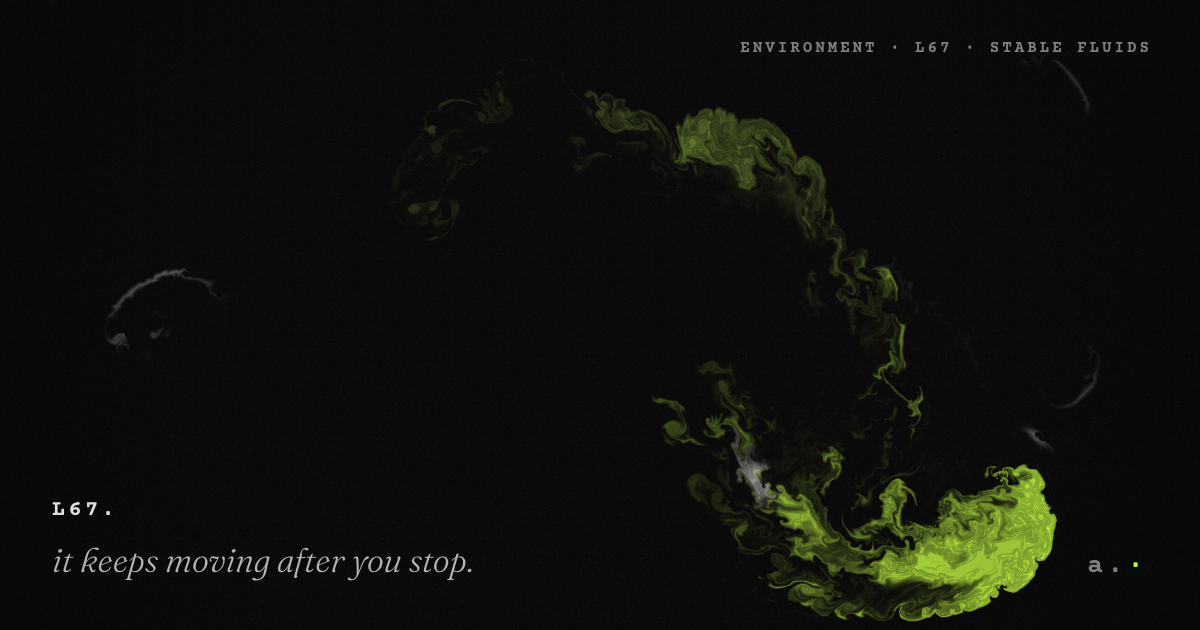
L65 gave the field state. L66 gave it agents. L67 gives it physics: a stable-fluids solver where five GPU textures — velocity, pressure, divergence, curl, ink — constrain each other every frame. The velocity field is forced to stay incompressible by twenty Jacobi relaxations of the pressure Poisson equation and a gradient subtraction, then everything is carried through the corrected flow semi-Lagrangian style. About thirty shader passes a frame, and none of them is the picture — the picture is just ink riding the result. Ink carries two channels, density and freshness, and freshness decays faster: whatever you just stirred is lime, and it cools to cream in a few seconds while the vortices you made keep turning. Drag to stir. Tap to drop. E-minor drone underneath; the lowpass opens with the stir.
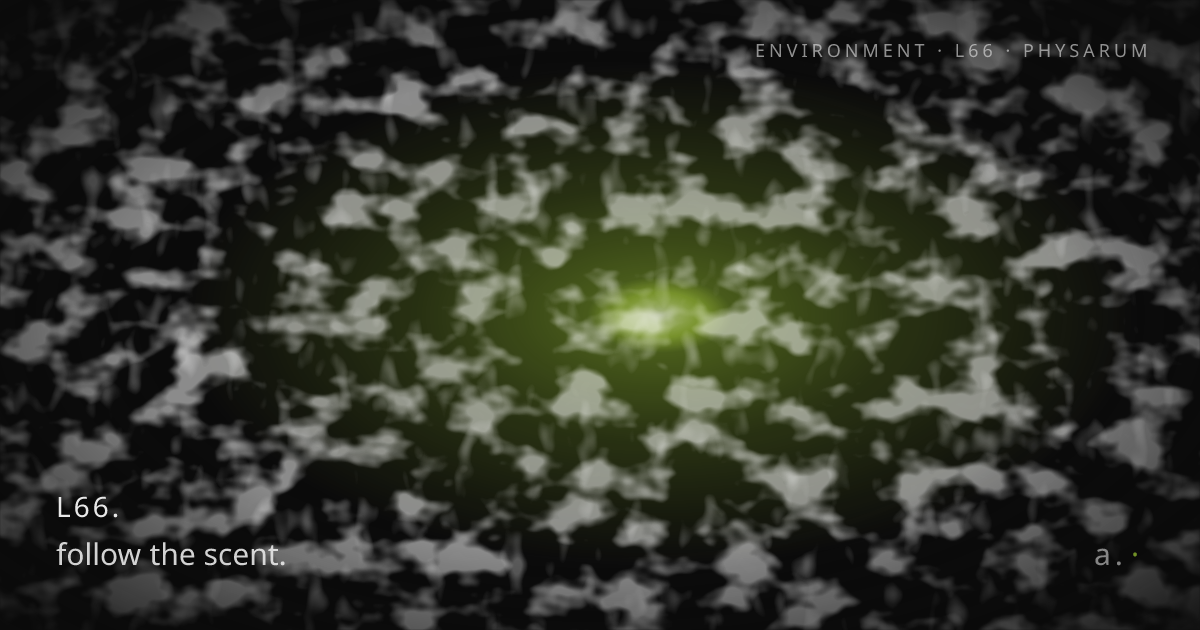
L65 had ONE state texture (a single chemistry field). L66 has TWO — and they interact. The first is the trail map (768×432, the same kind of texture L65 used). The second is the AGENT texture (128×128, encoding 16,384 particles' positions and headings, one per pixel). Each frame: every agent reads the trail map at three angles ahead, turns toward the strongest scent, walks forward, and the trail map then decays + diffuses + has new agent positions deposited additively. The result is a self-organizing vascular network — agents reinforce each other's paths until what emerges looks exactly like Physarum polycephalum solving a maze. Drag attracts (cursor biases each agent's heading); tap scatters a fresh ring of agents at the cursor that immediately joins the chase. C-minor drone underneath, slightly cooler than L65's A-minor.
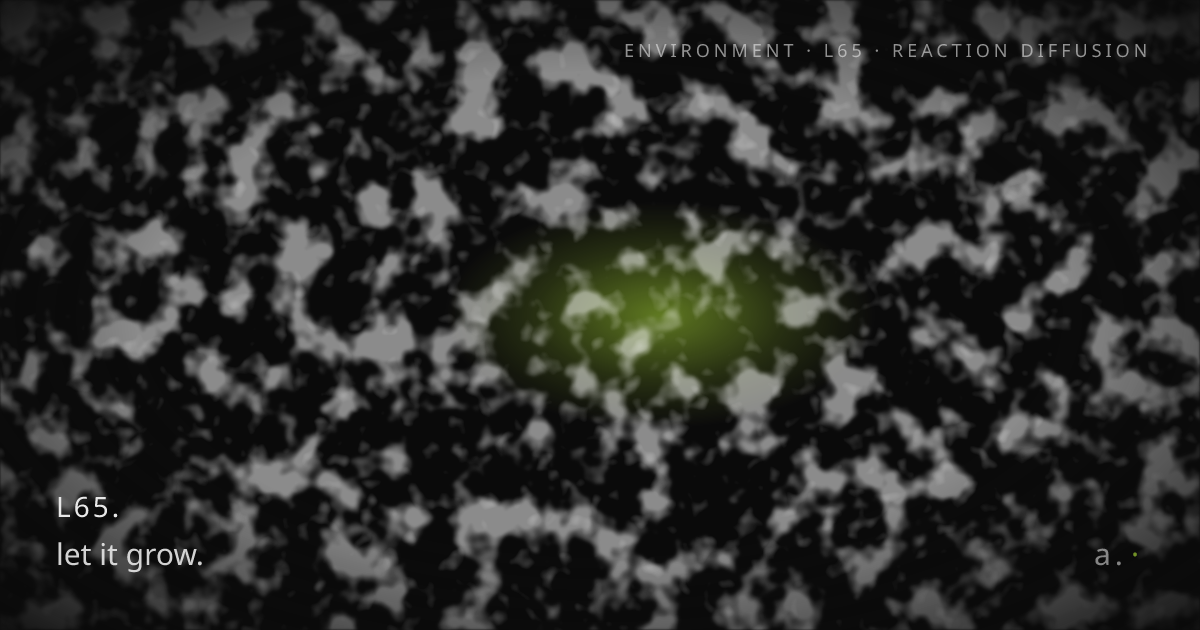
L60–L64 were all per-pixel-per-frame fragment shaders — deterministic functions of (x, y, t). L65 introduces actual STATE: each pixel's value depends on its previous value and its 8-neighbor average, updated by writing to one framebuffer while reading from another, then swapping. This is the classic ping-pong simulation pattern, and it's the unlock that lets pieces evolve over time rather than just be re-derived from coordinates. The chemistry is Gray-Scott reaction-diffusion (U + 2V → 3V), feed/kill coefficients chosen for 'mitosis' morphology — circular spots that form, grow, divide into two, drift apart, and start again. Drag injects activator (V) at the cursor — drawing seeds new growth wherever you go. Tap perturbs the kill coefficient briefly so the pattern morphology shifts (spots ⇄ maze) before it relaxes back. Warm A-minor ambient drone underneath. Let it grow.
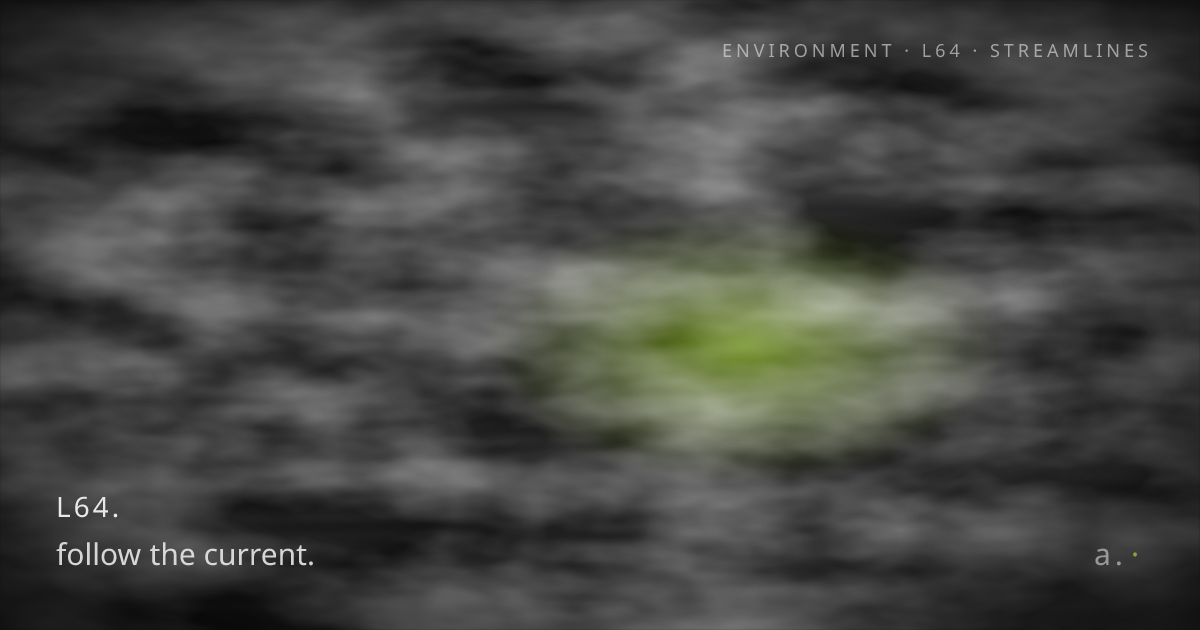
Another step in the rendering arc: L60 was a 2D fragment shader, L61–L63 added 3D geometry and refraction. L64 turns the WHOLE SCREEN into a flow visualization — no surface, no volume. Every pixel computes its own backward streamline through a 2D curl-noise vector field: 24 RK1 steps backward at h=0.02, accumulating brightness from a second fbm sampled along the trail. Curl-of-fbm gives an incompressible (divergence-free) field, which is why the result reads as flowing fabric — currents that swirl but never bunch up or vanish. The cursor adds a perpendicular vortex source, so dragging bends the streamlines locally. Tap = cream-to-lime pulse glow + the master lowpass opens (deep C2/G2/C3 drone underneath, pitched lower than L62 to feel like a real current). Follow the current.
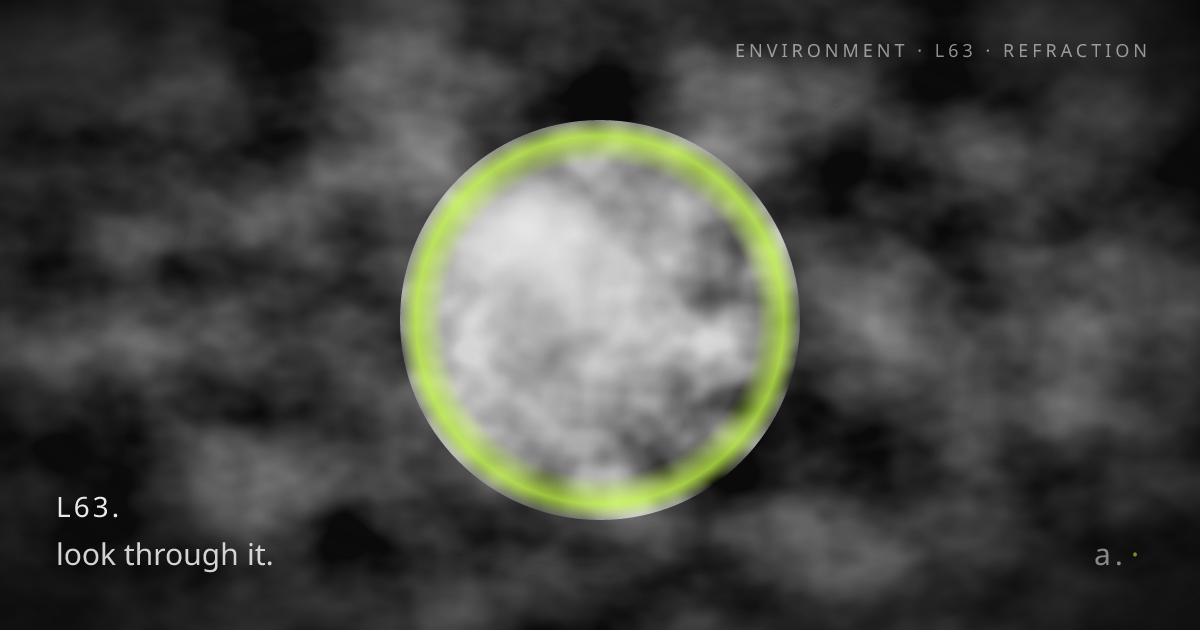
Step in the rendering arc: from L62's opaque surface to a refractive one. A glass marble rolls across a domain-warped FBM cloud field — the same 'weather' pattern from L60. Each pixel that hits the sphere refracts twice (entry + exit, IOR 1.45) and samples the cloud field at the bent destination, so the field appears warped through the glass. A Fresnel term shifts the surface toward lime at grazing angles (the marble's rim), and a 3D fbm swirl is sampled inside the sphere for the colored ribbon a real marble has. Drag to roll the marble; tap to nudge.
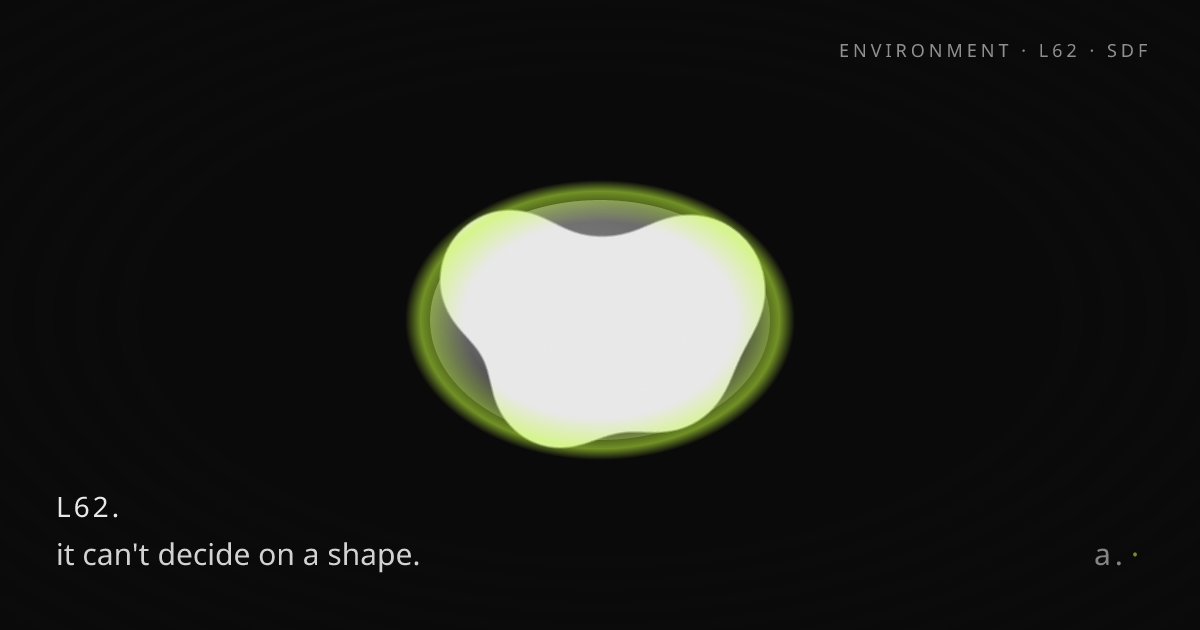
From L61's volumetric noise (no surface) to actual 3D geometry with an explicit smooth surface. Five spheres orbit a center at different frequencies and radii; the SDF combines them via cubic-polynomial smooth-min so they merge into a single morphing blob — like a drop of mercury that won't settle on a shape. Per pixel: ray-march to the surface, estimate the normal via 6-tap finite differences, compute Lambert diffuse from a cursor-driven light, march a soft-shadow ray, and add a Fresnel rim that shifts the cream surface toward lime at grazing angles. Drag horizontally to orbit; tap to shudder the spheres briefly (perturbs each radius by 45% before settling back).
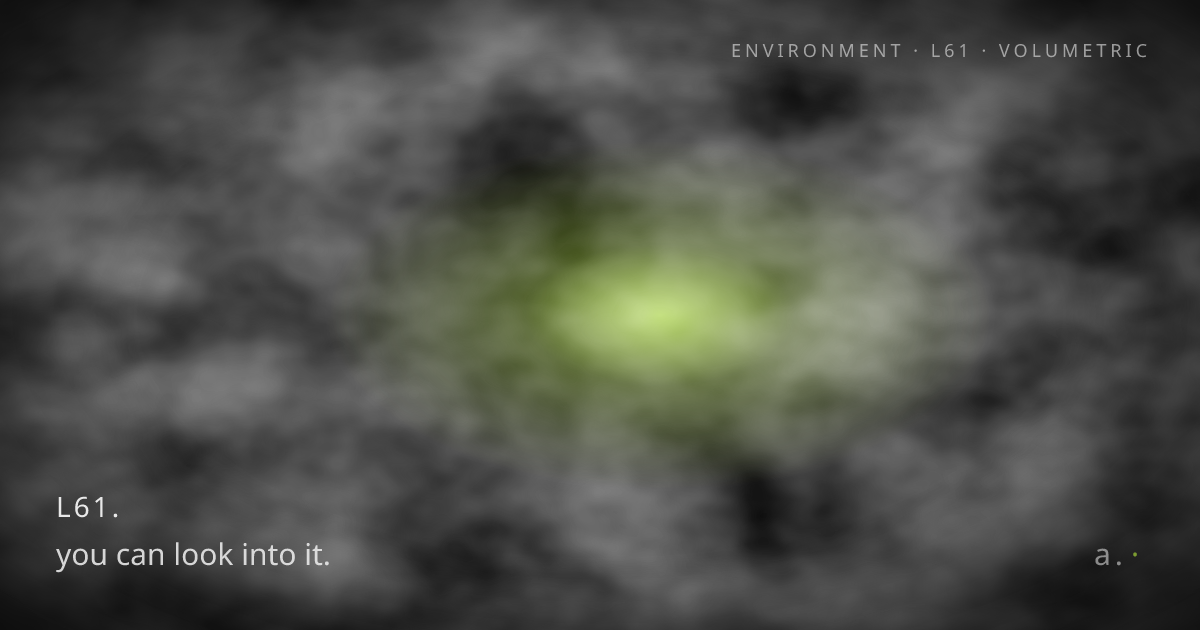
From L60's 2D fragment shader to actual 3D — a ray-marched volumetric noise cloud that you can see *into*. Each pixel marches a ray through a 3D fbm volume, sampling density at every step, and at lit samples shoots a second ray toward the cursor for a cheap soft-shadow. Front-to-back alpha accumulation builds the cloud's depth and self-occlusion. Drag horizontally to orbit the volume; tap to bloom the light through it. The volume drifts on its z-axis over time so the structure is never quite static.
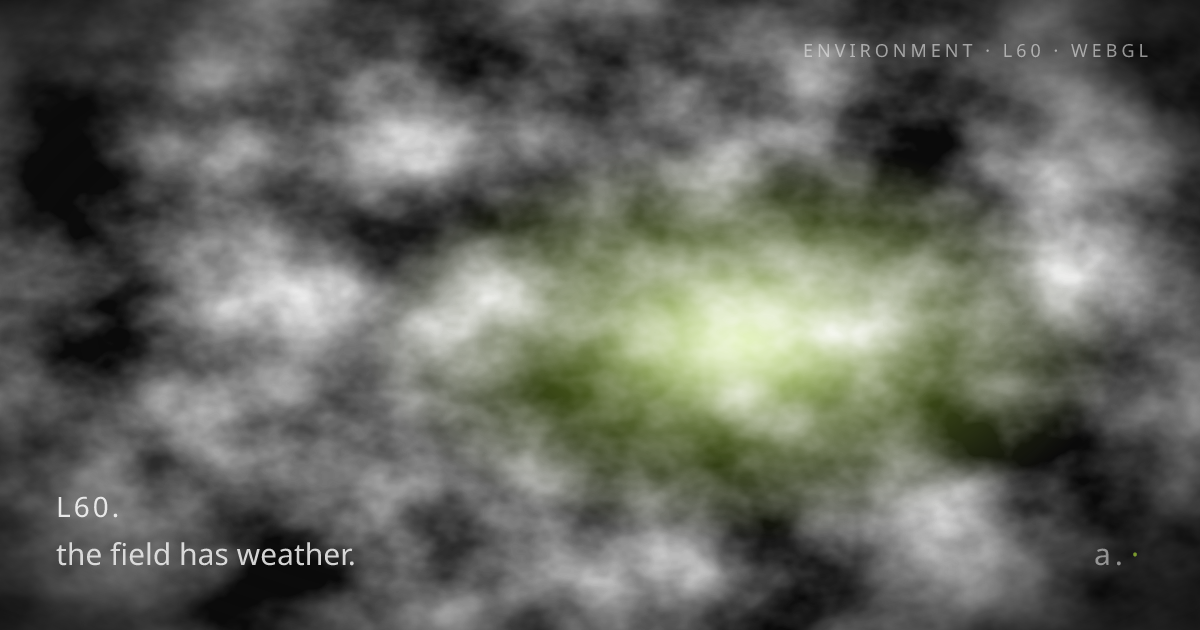
The first WebGL piece — the unlock at L60. A fullscreen fragment shader runs domain-warped FBM noise per pixel, every frame: cream cloud structure flows continuously across a dark field, never repeating. The cursor is a soft point light — areas near it lift toward lime, and the light reveals more of the cloud's structure rather than just sitting on top. Drag to move the light through the field; tap to send a brief pulse that blooms outward. An ambient drone of three detuned octaves of A starts on first tap; the lowpass cutoff opens on each pulse so you hear the bloom too.
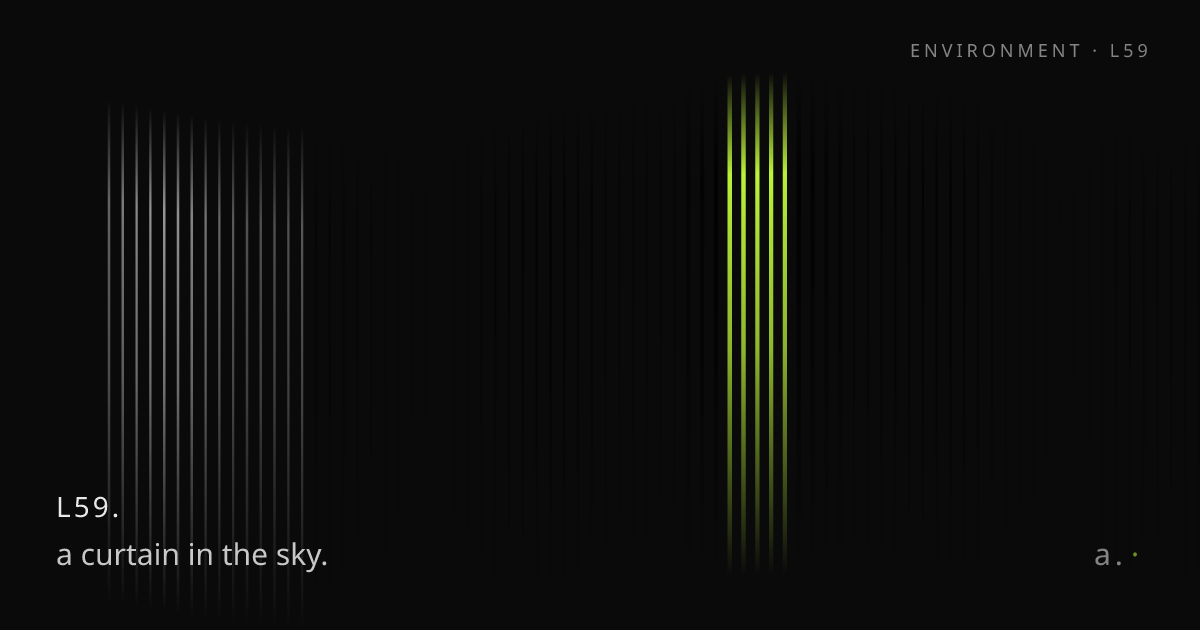
An aurora. 180 vertical ribbons placed along a slowly undulating arc in 3D, each rendered with a soft top-and-bottom fade so the curtain hangs in the sky without hard edges. Two traveling waves drift across the arc, brightening some bands and dimming others — the slow shimmer of polar light. Drag horizontally to orbit; vertically to dim or amplify the whole sky. Tap to inject a substorm — a pulse propagates outward in both directions from the tap, lighting the curtain lime where it passes. The sky hums louder when the curtain is bright.
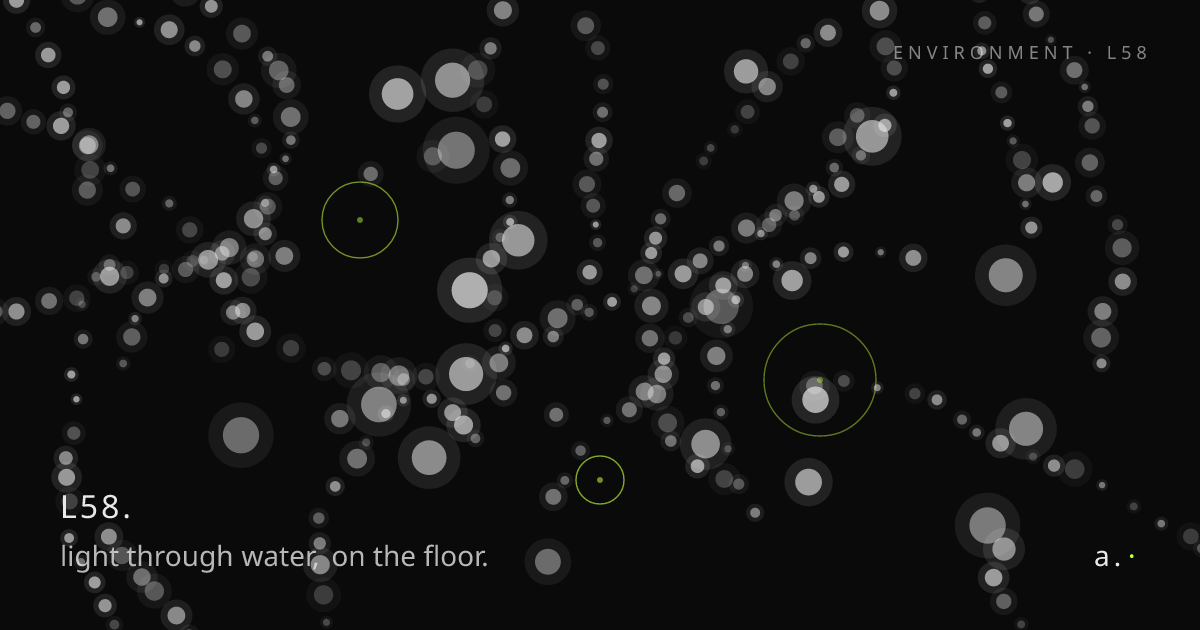
The floor of a virtual pool, lit from above. A water surface modeled as five moving sine waves refracts vertical light onto the floor — bright cream streaks form where rays converge. Drag the cursor to ripple the water; tap to drop a stone (a circular wavefront propagates outward, decays over a few seconds). A lime ring traces each wavefront from its origin. The water rumbles louder when the surface is busy.
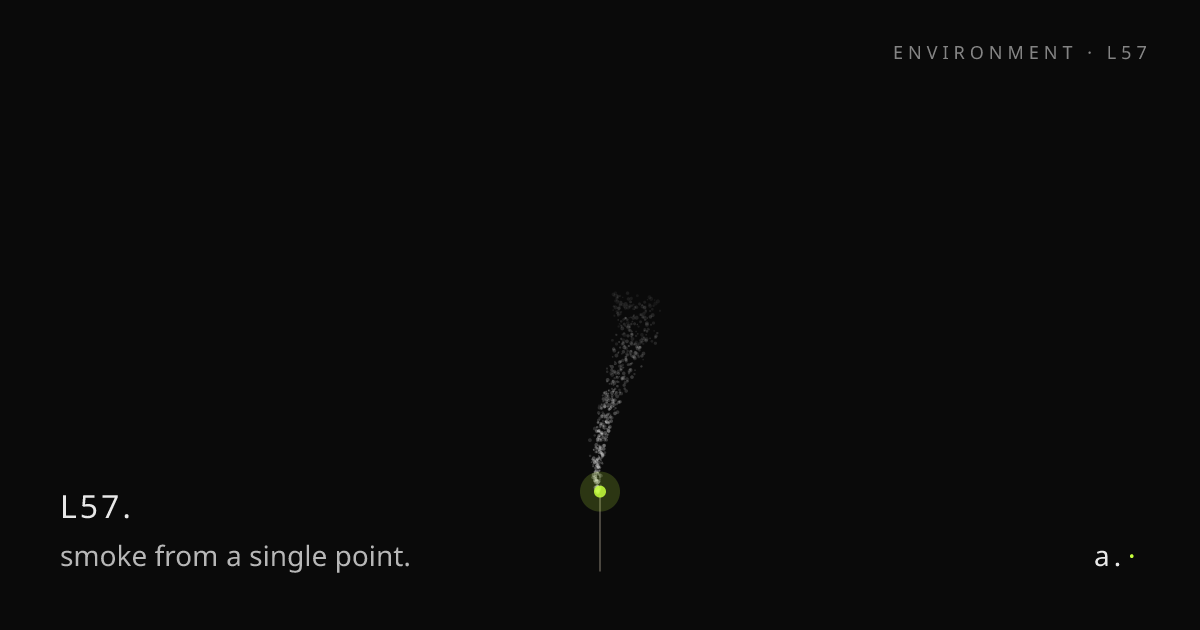
A single thin column of smoke rising from a lime ember at the base of a dark plate. Up to 720 cream particles emit at the source, drift upward through buoyancy that weakens with altitude, and curl sideways through a 3D drift-noise vector field. Drag to orbit the column. Tap to send a wind gust from screen center toward the tap — the column briefly leans, then resettles. The air rumbles when the column is dense.
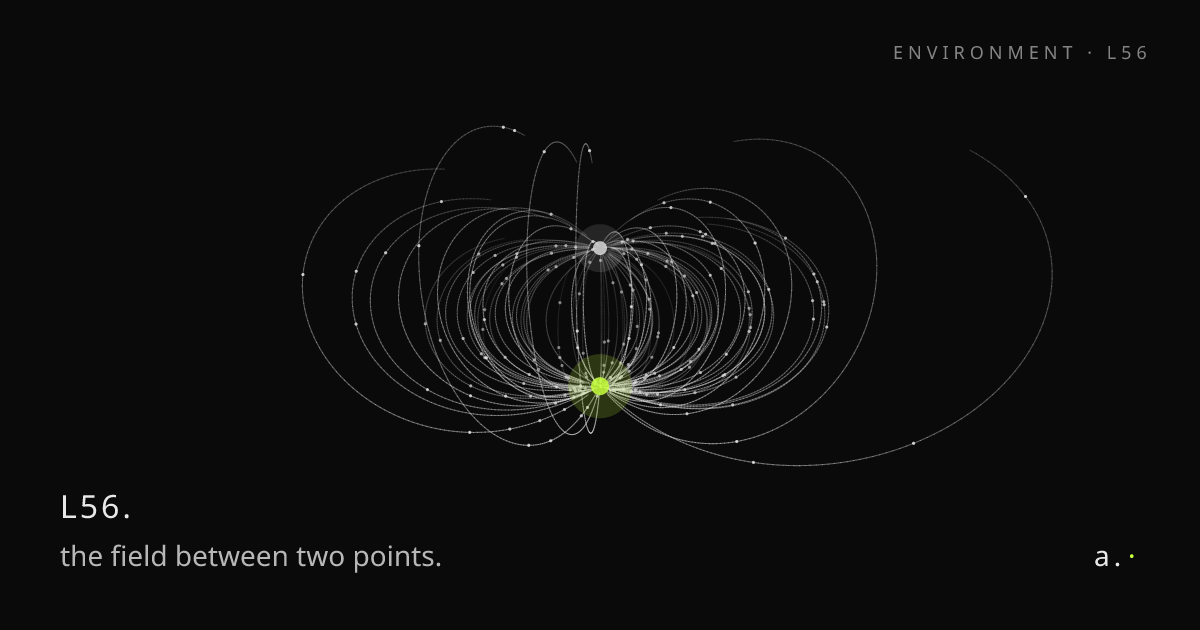
An electric dipole in 3D — lime + above, cream − below. 540 cream particles flow along the local field, which is the sum of two softened 1/r² vectors pointing away from + and toward −. Trails fade behind. Particles that fall into the − pole respawn near + so the streamlines stay dense. Drag to orbit; drag vertically to pull the poles apart or push them together; tap to swap polarity — the whole flow reverses. A low sine drone tightens its pitch when the poles get closer.
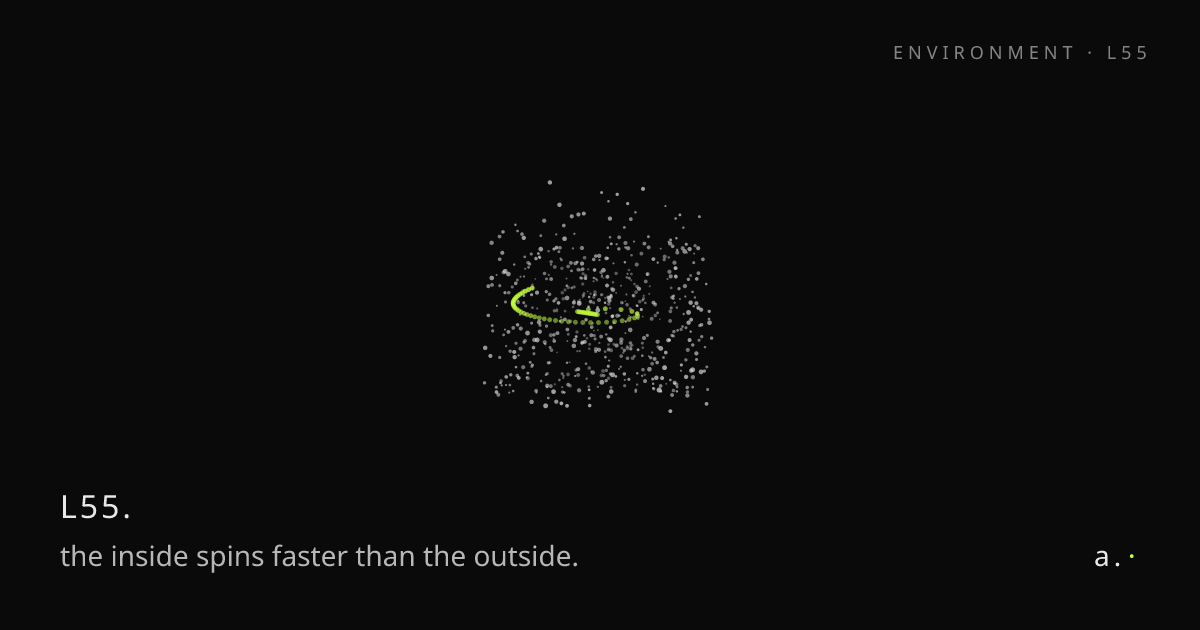
A Rankine vortex of ~640 cream points in 3D. Inside the core, every point rotates at the same angular speed — solid-body rotation. Outside, angular speed falls as 1/r so the tangential velocity stays constant. A lime tracer line at h=0 starts as a clean radial spoke and winds itself into a tighter spiral as the inner points lap the outer ones. Drag horizontally to orbit; vertically to crank the vortex; tap to scatter. The wind hisses higher and louder when you push it.
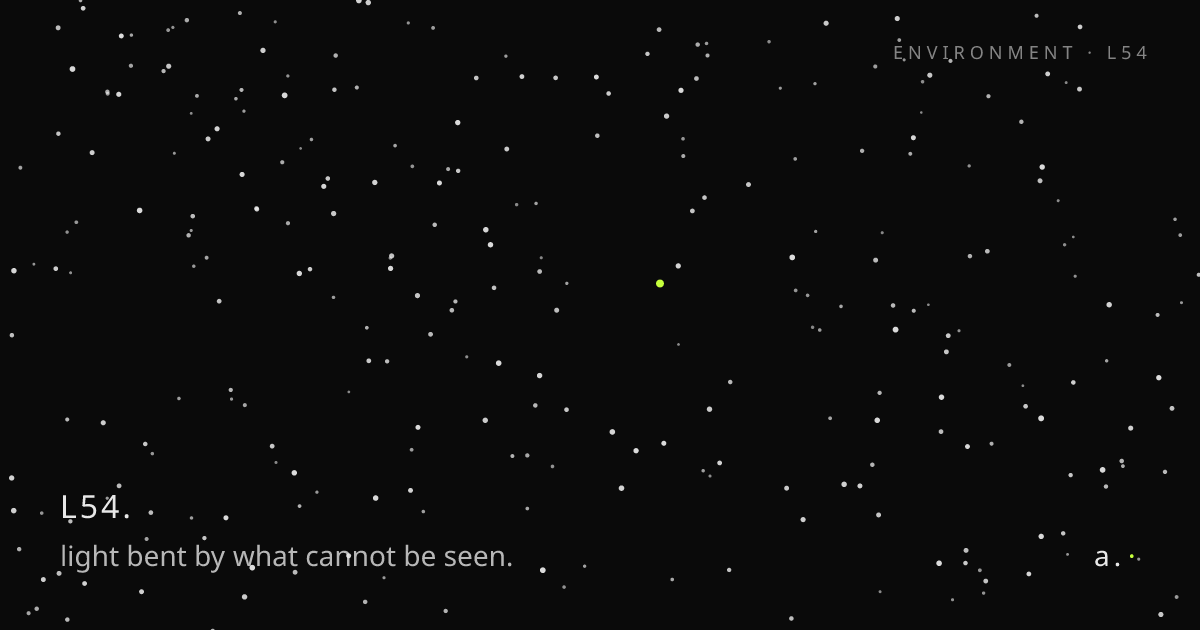
Weak gravitational lensing. A parallax-weighted field of ~520 stars on a dark plate; your cursor is an invisible mass. Each star's displayed position is offset toward the mass by strength / (r² + softening) — the classic 1/r lens formula — producing a distorted disk near the mass and barely any effect far away. Press to make the mass heavier; release to let it relax. A single sine drone tracks total displacement: space hums louder and higher when it's bending hard.
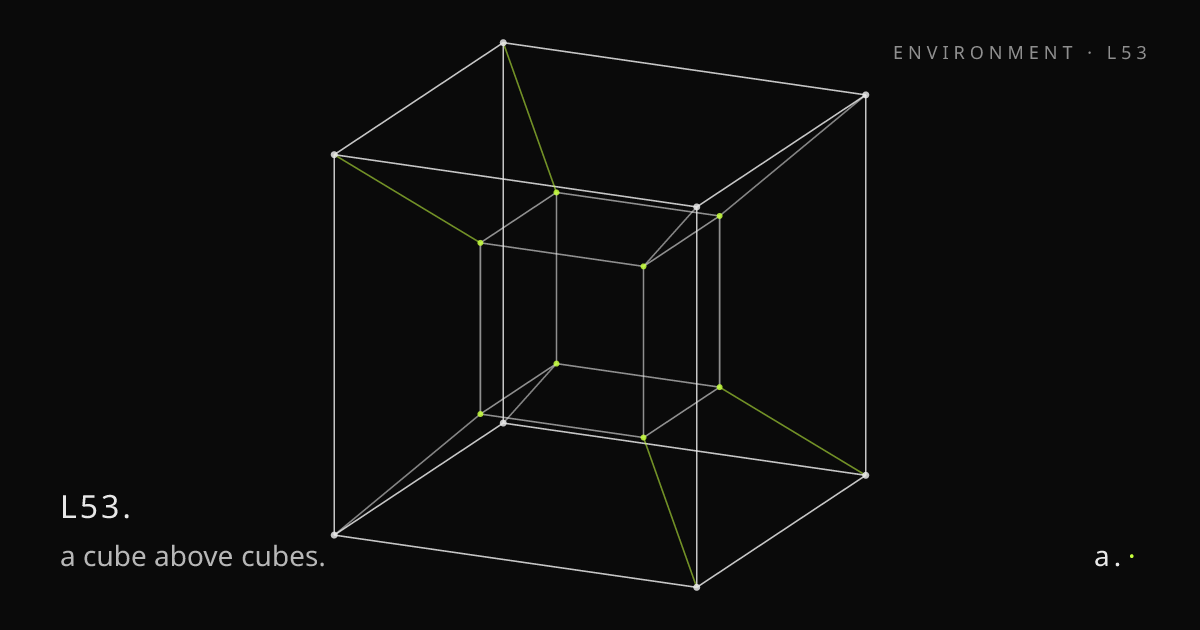
A tesseract — a 4D hypercube. 16 vertices, 32 edges. Rotates in a chosen 4D plane (XW, YW, or ZW) plus a slow tumble in XY. Drag to move the 3D camera; tap to cycle which 4D plane is rotating. Edges fog with depth; vertices whose w-coordinate is positive tint lime — the 'outer cell.' Four sine voices at G3–C4–E4–G4 panned by the projected-x of four anchor vertices: you can hear the shape turn.
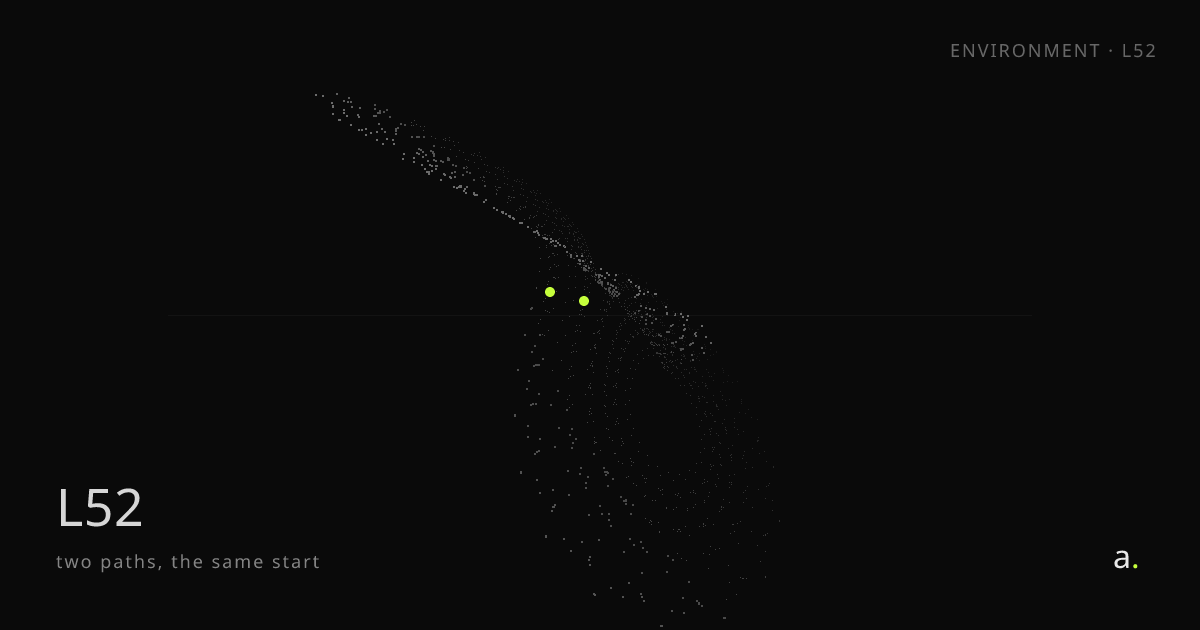
Two Lorenz attractors in 3D, integrated from near-identical initial conditions (differ only at the fifth decimal). For a few orbits they walk the butterfly together; within seconds they're on opposite wings. Perspective with depth fog, slow auto-rotation; trails of ~700 points each, heads marked with lime. Drag to tilt; tap to reseed with a new tiny perturbation. Stereo sines panned to each head — you hear them drift apart.
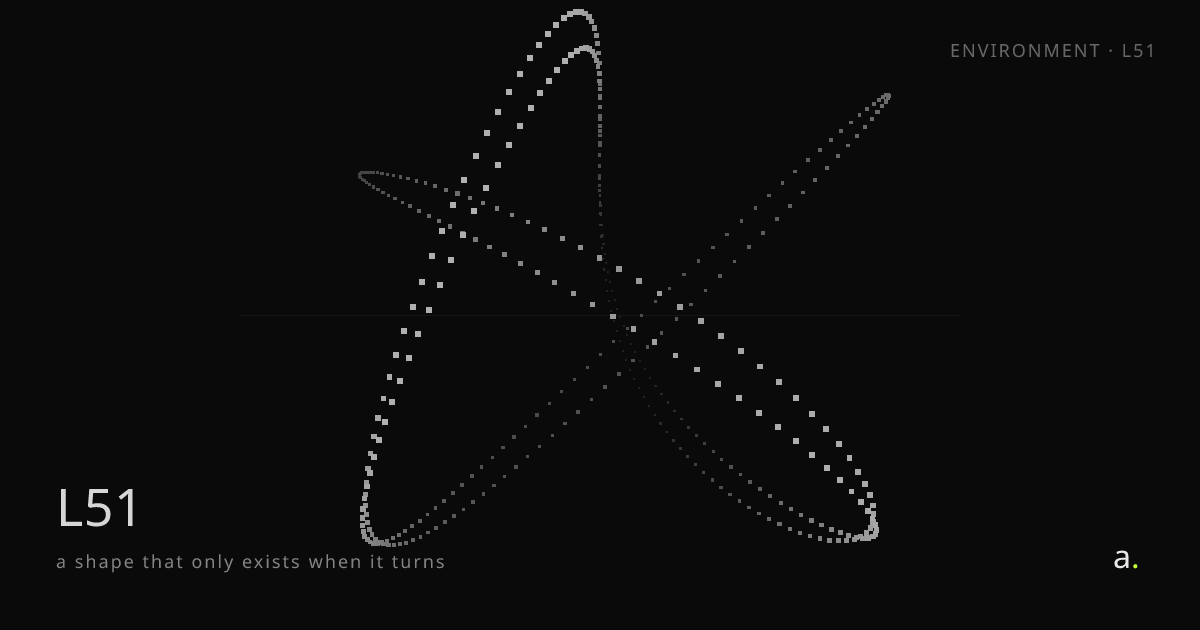
A Lissajous torus knot in 3D — 600 points on a closed curve x=sin(3t), y=sin(4t+π/5), z=sin(5t+π/3), rotating around the vertical axis. Perspective projection with depth fog: near points bright, far points dissolve. The static curve is illegible; only rotation reveals the 3D shape. Drag to spin; tap to ring a lime pulse along the curve. The first Environment-tier piece.
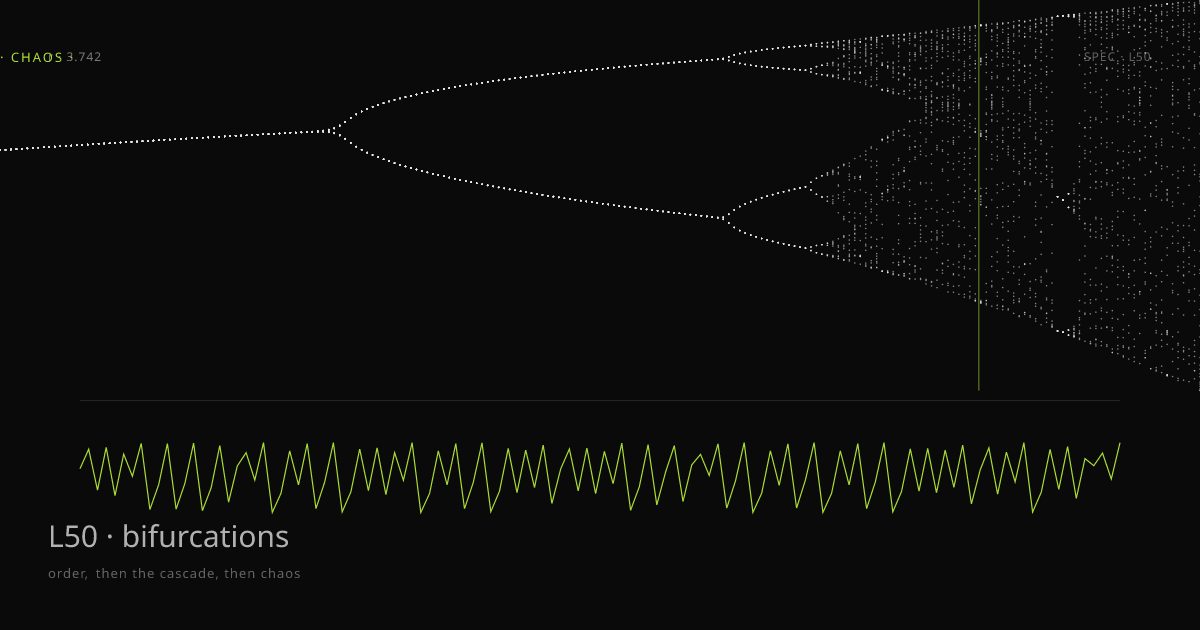
The logistic map x → rx(1−x), rendered as a full bifurcation diagram. A single fixed point, then period 2, 4, 8… up to the Feigenbaum point r_∞ ≈ 3.5699, and then chaos broken by periodic windows. Drag to move r; a lime time-series shows the live orbit; the period detector names what you're watching. The System tier closes here.
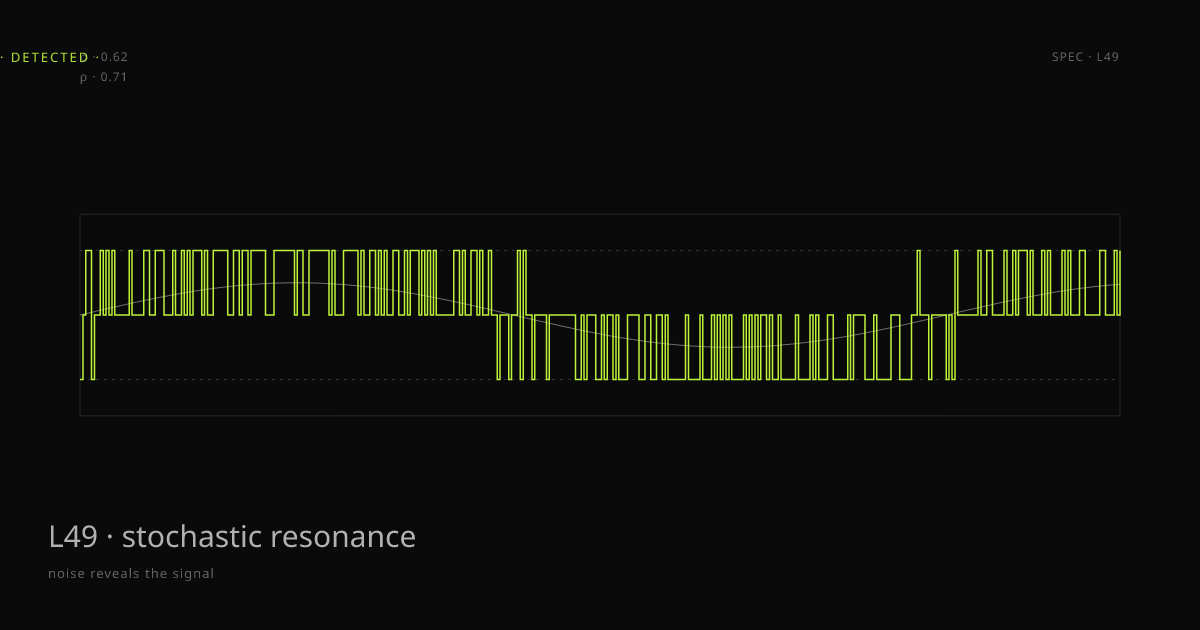
Stochastic resonance. A periodic signal sits beneath a hard detector threshold — too weak to trigger it on its own. Add noise (drag vertically); at the Goldilocks σ, the detector starts tracking the signal, and correlation crosses the detection threshold. More noise makes the signal findable.
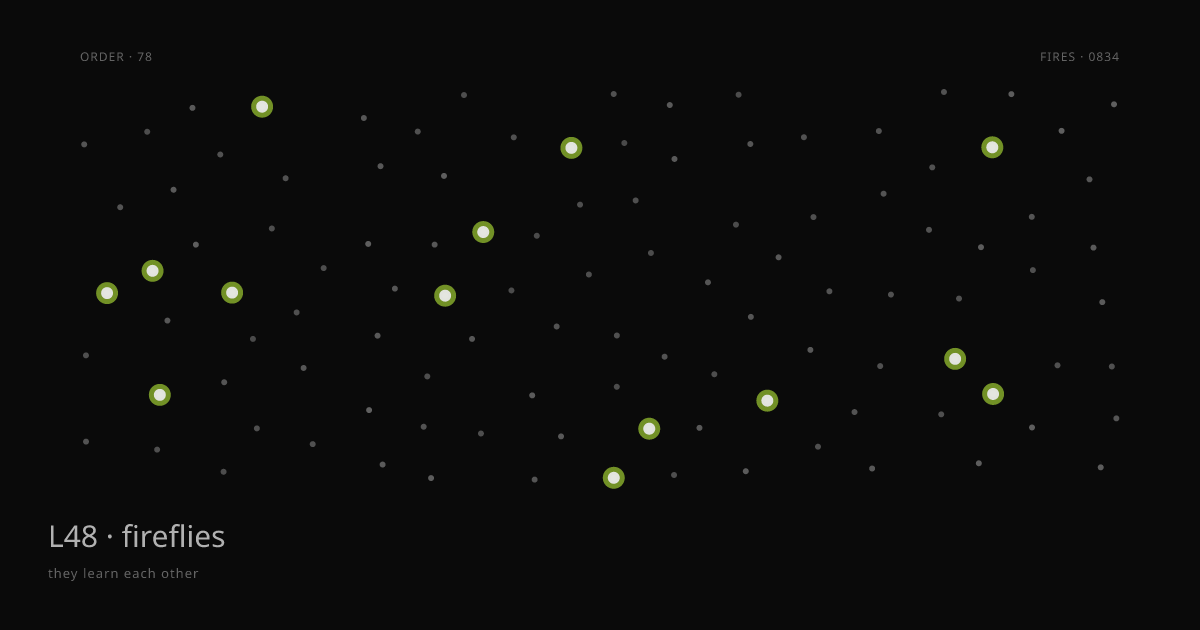
110 Mirollo–Strogatz pulse-coupled oscillators. Each fire bumps every other phase forward by epsilon. Random at first — then, over about thirty seconds, the whole field flashes in unison. Different mechanism from L46: discrete pulses, not continuous coupling.
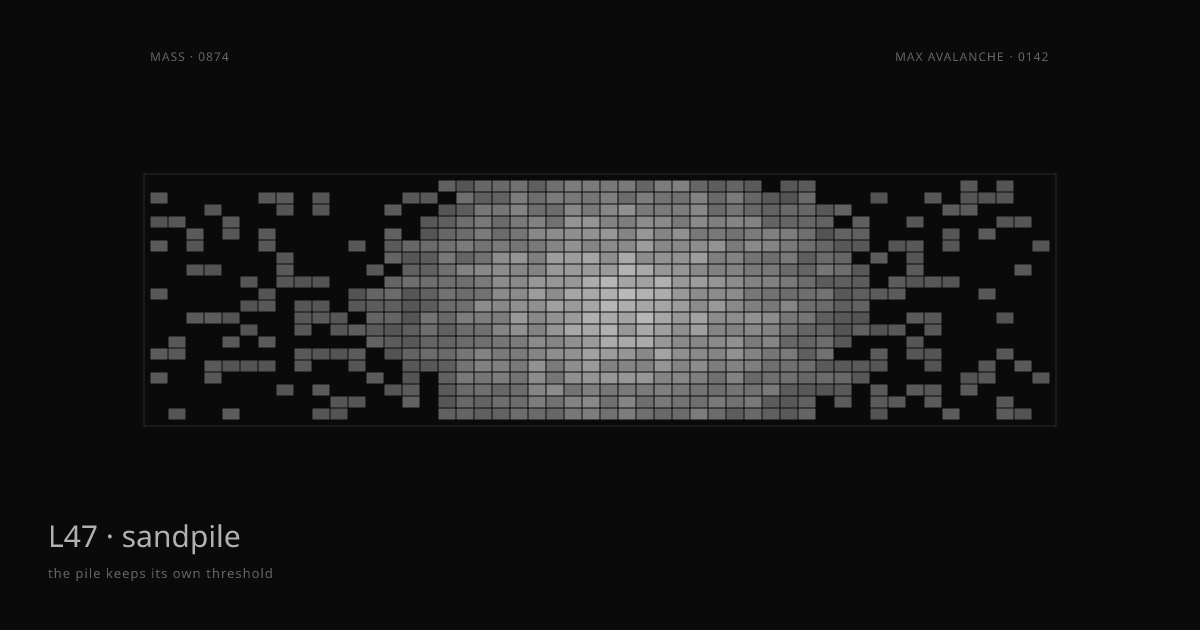
Abelian sandpile — self-organized criticality. Drop grains; any cell that holds four topples and feeds its neighbors, and cascades sometimes span the grid. No one sets the threshold; the pile keeps its own.

A Kuramoto pair — two coupled oscillators. Drag coupling K past the critical threshold and they phase-lock: two sine tones beating at 3 Hz resolve into clean unison. Synchronization as a phase transition.

Site percolation on a 72×72 grid. Drag the dial to raise p from 0 to 1. Past p_c = 0.5927, one cluster suddenly spans the grid edge-to-edge — the first v3 SIGNAL escalation, and the moment something first reaches the other side.

The Ising model — a 256×256 ferromagnet. Drag up to cool, down to heat. Approach the critical temperature and watch order crystallize from chaos; at Tc, domain boundaries go fractal.

Wave Function Collapse: an 18×18 grid of circuit tiles starts as pure superposition. The lowest-entropy cell collapses first; the rest must agree. Coherent structure emerges from constraint.

Lenia — continuous Game of Life. Cells carry weight, not on/off. Ring-shaped creatures form, swim, dissolve. The smooth version of life.

A 3D wave pool. Tap to drop a stone; waves propagate, interfere, reflect. The wave equation in perspective.

Four triply-periodic minimal surfaces — gyroid, Schwarz P — ray-marched in real time. Each surface divides all of space into two equal labyrinths. Drag to orbit.

A Mandelbrot explorer with a live Julia preview. Tap to zoom 3×. Every point of the Mandelbrot set corresponds to a different Julia set — a universe per pixel.

Real-time Navier–Stokes fluid simulation. Drag to stir citrus dye into the flow. The fluid remembers where you touched it.

The hodgepodge machine: a cellular automaton modeled on the BZ reaction. One rule per cell, pinwheels everywhere. Chemical-looking spiral waves with no chemistry.

Particle Life: 400 particles in five species, a hidden matrix of who-attracts-whom. The same matrix self-organizes into spirals, crystals, predator–prey cycles. Tap to rewrite the rules.
2,000 particles settle into Chladni figures — the standing-wave patterns on a vibrating plate. Tap to change frequency; sound and vision lock together.

20,000 agents trace Physarum polycephalum — the slime mold that finds shortest paths. Tap to place food; the network grows to connect everything.
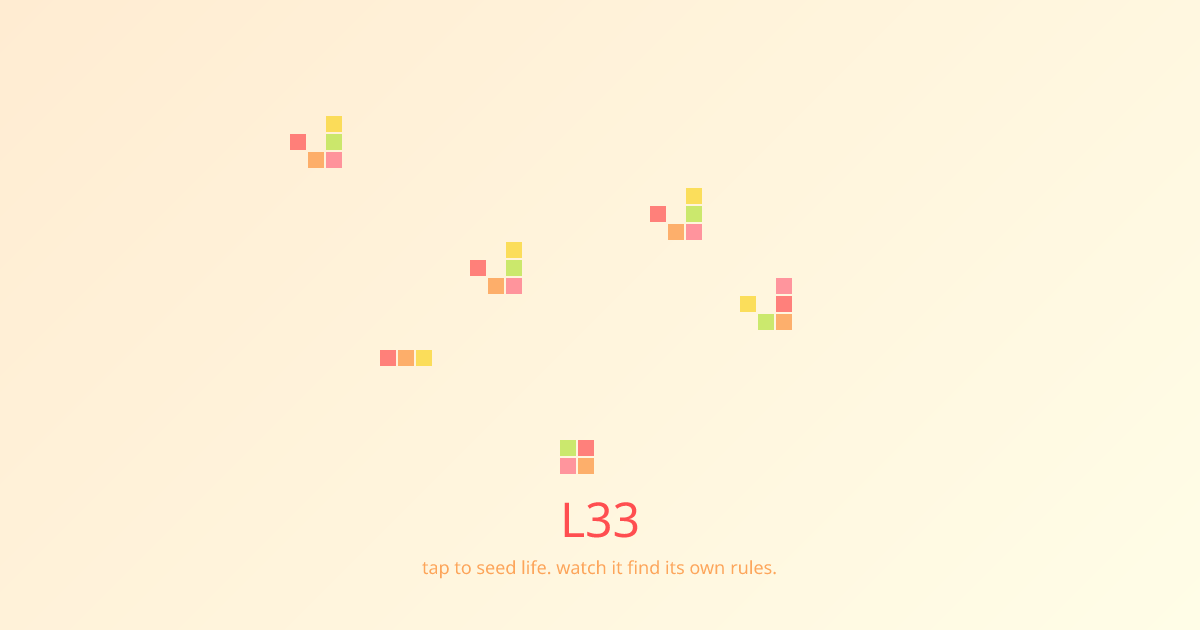
Conway's Game of Life. Tap to place gliders; watch them collide, oscillate, die. Each birth chimes.

Three magnets and one pendulum. Every starting position maps to whichever magnet it ends on — but the map is a fractal. Chaos has its own geography.
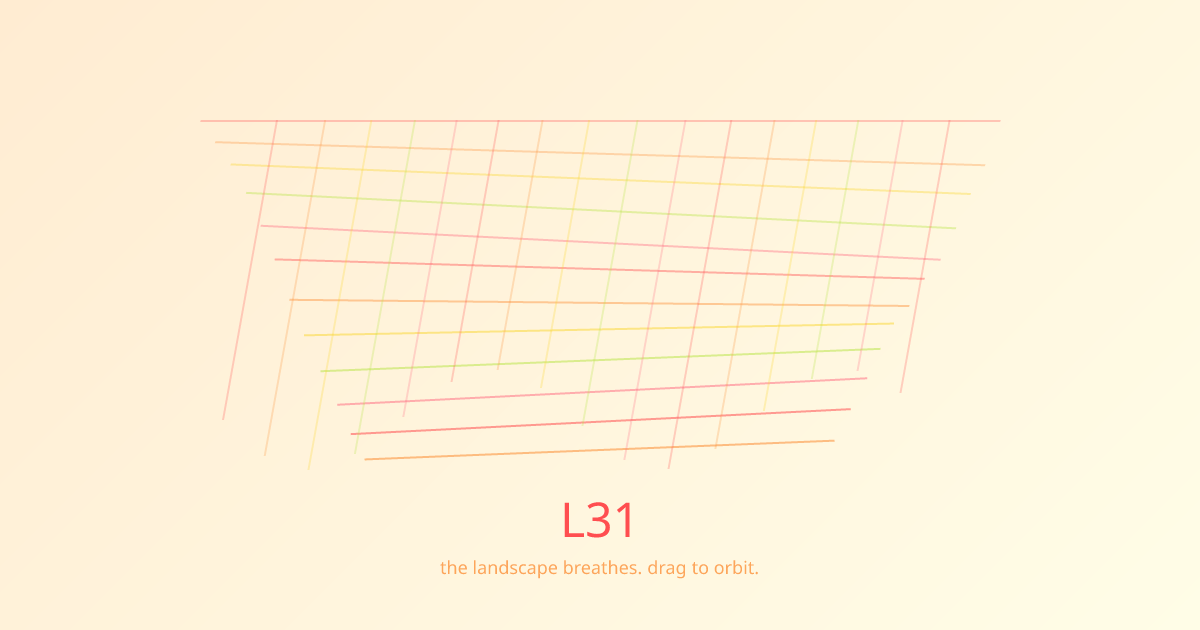
3D wireframe terrain from FBM noise. Peaks and valleys morph over time. Drag to orbit the landscape as it breathes.

600 particles trace the Lorenz butterfly in 3D perspective. Chaos has a shape — and here it is. Drag to rotate.
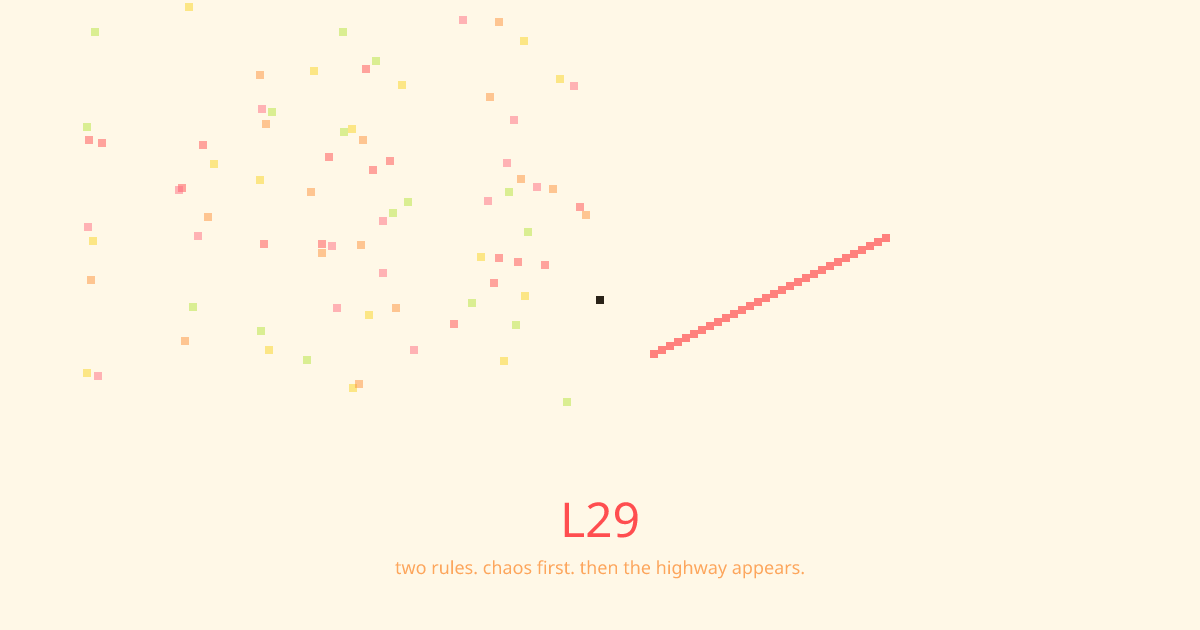
Langton's ant: a single cell on a grid with two rules. 10,000 steps of chaos and then, from nowhere, an emergent highway begins to draw itself.

Diffusion-limited aggregation. Particles wander, and when one touches the crystal, it sticks. Chaos, one random step at a time, becomes coral.
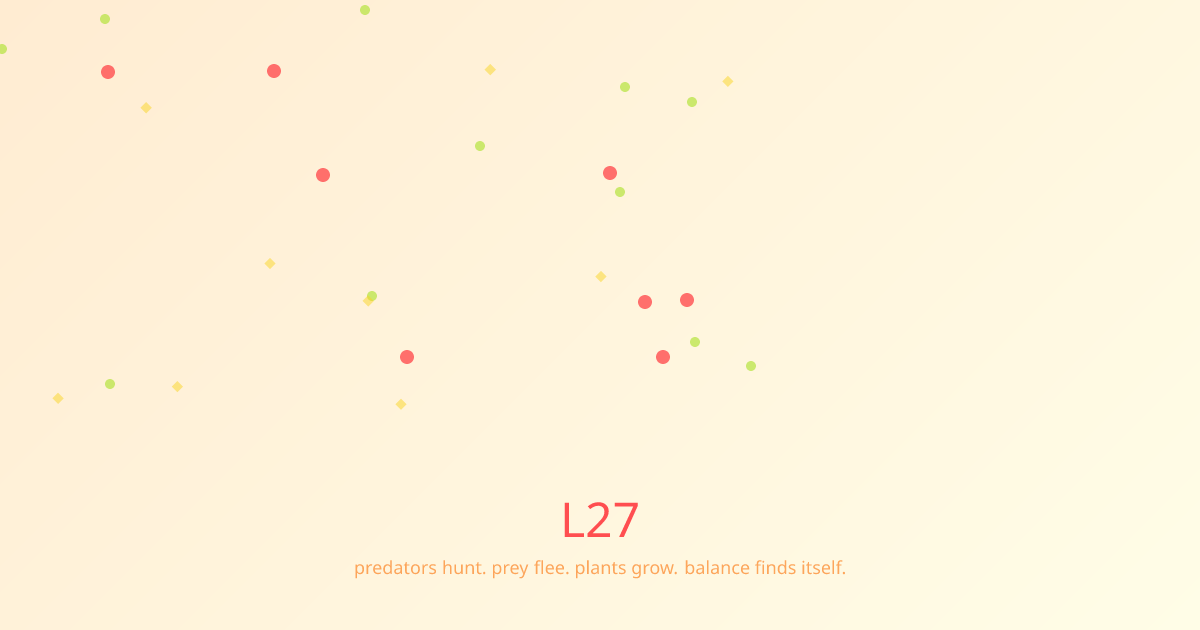
Three species on a field: predators hunt, prey flee, plants grow. Lotka–Volterra dynamics that balance, or collapse, depending on where you poke them.

320,000 points, one rule iterated over and over. No plan — the shape finds itself. Seven Clifford attractors to cycle through.
Fifteen pendulums of increasing length. They start in sync, drift into waves, and re-sync every 60 seconds. The composition tier closes on a quiet one — they drift apart, they always come back.

Spinning arms at different harmonics draw a hidden curve — Fourier epicycles. Every curve in the world is just circles rotating at different speeds.
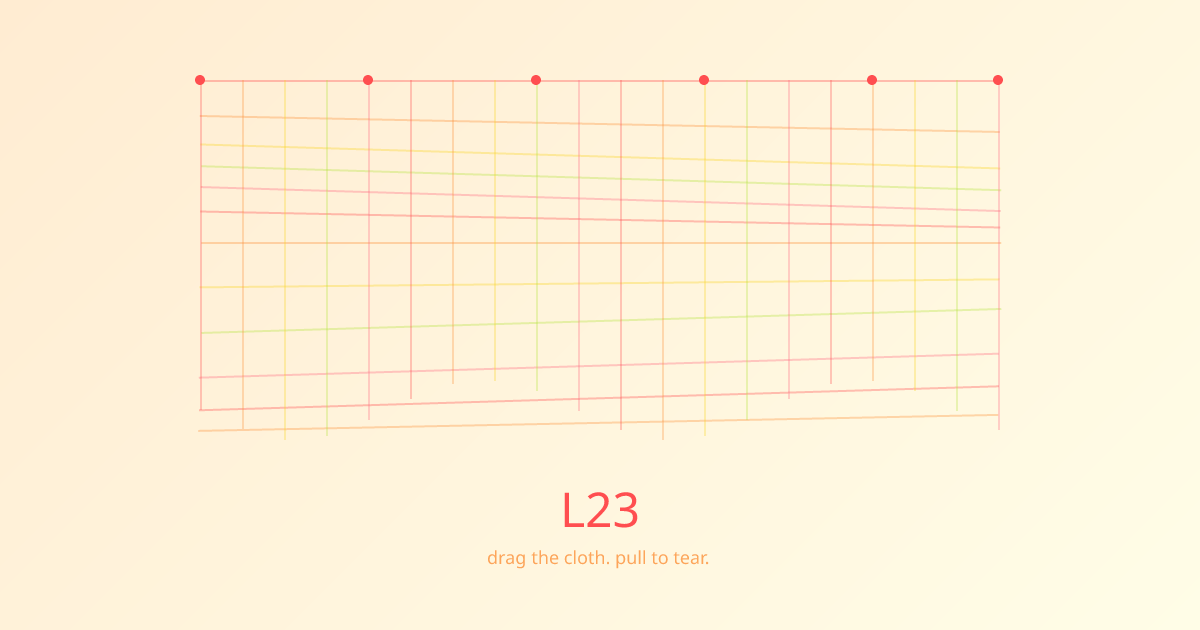
A cloth of citrus threads, held up by verlet physics. Drag to pull it around. Pull too hard and the fabric tears.

Gray–Scott reaction–diffusion: two virtual chemicals, coupled PDEs. Drag to seed; double-tap to shift chemistry between coral, spots, maze. Real chemistry, emergent texture.
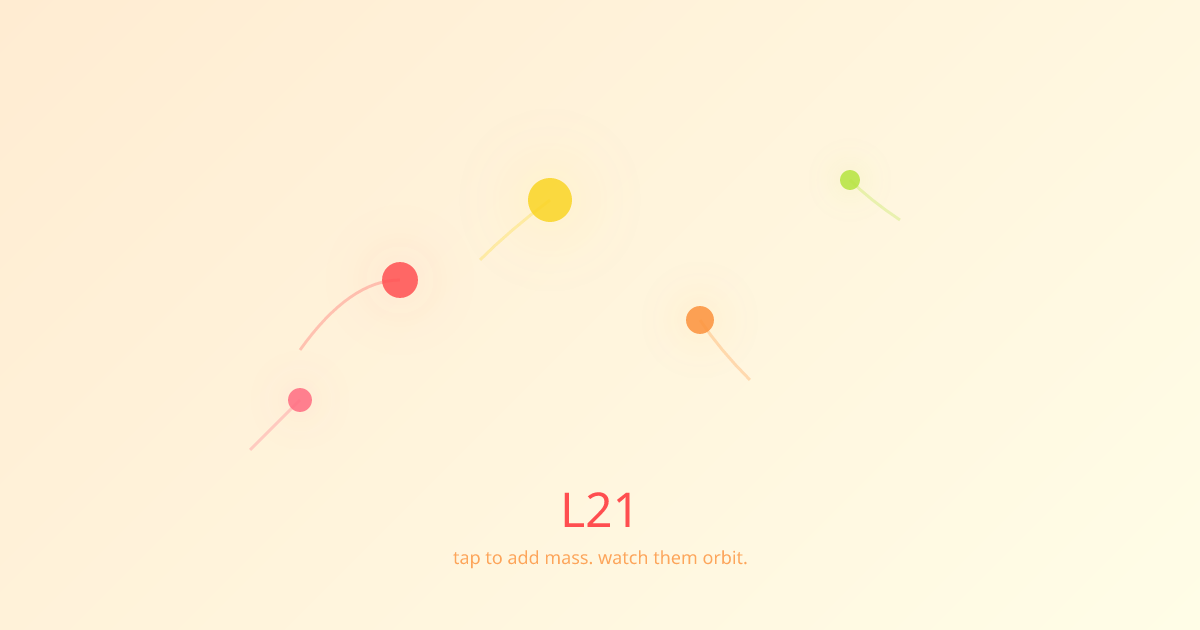
Tap to place masses. They attract each other with gravity, orbit, collide, merge. The n-body problem as a drawing tool.

700 particles follow an invisible vector field built from sin, cos, and noise. Drag to disturb the current. Fabric-like flow with an ambient drone.
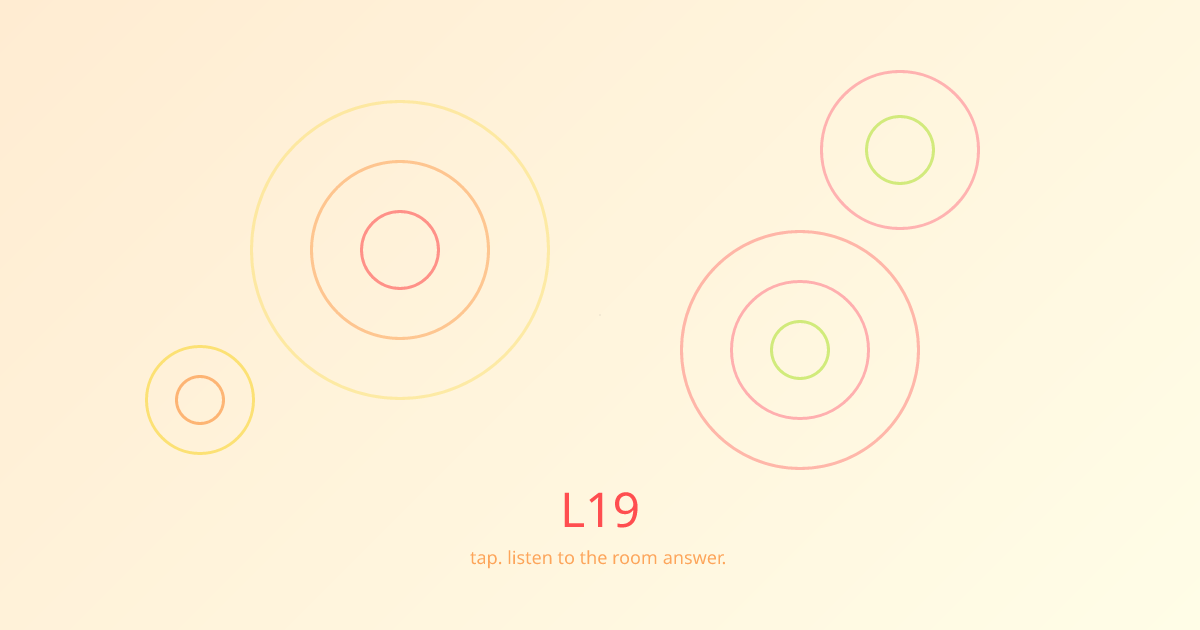
Tap to make a sound. It bounces off the edges of the screen, shifting pitch with each reflection. You hear the shape of the room.

Drag anywhere to play. X is pitch, Y is volume, four voices simultaneously. The screen as a continuous instrument.
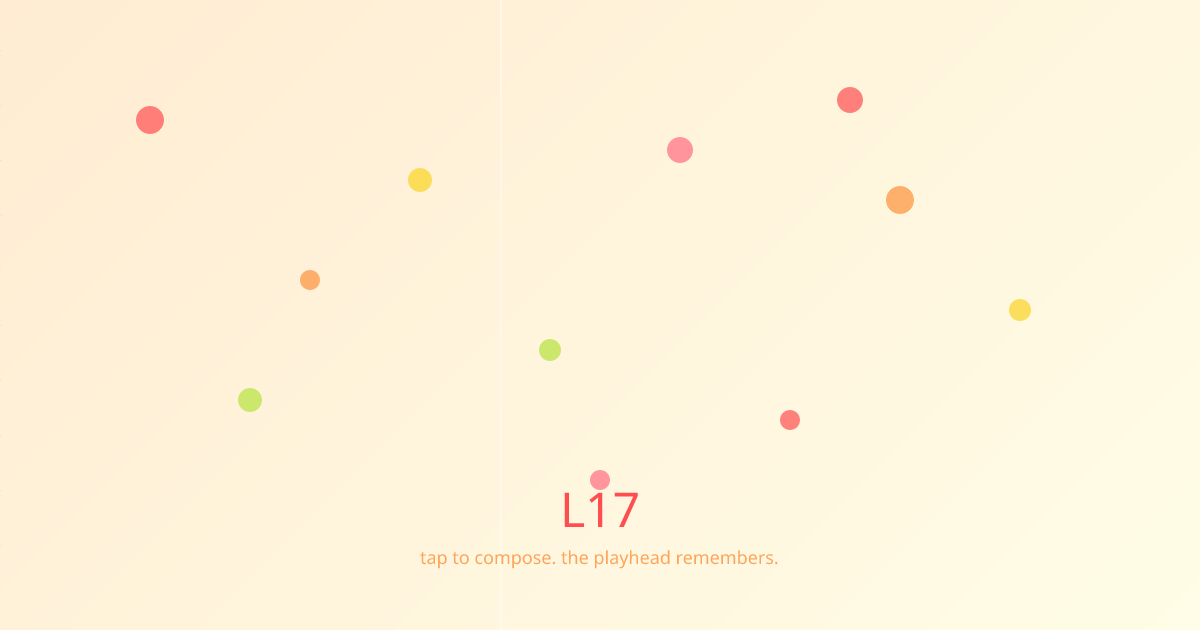
Place notes on a field; a playhead sweeps across, ringing each one. The screen becomes a musical score you compose by touching.

A drum machine — four voices, an eight-step sequencer. Tap pads to program, hit play. Rhythm as an object you program and observe.
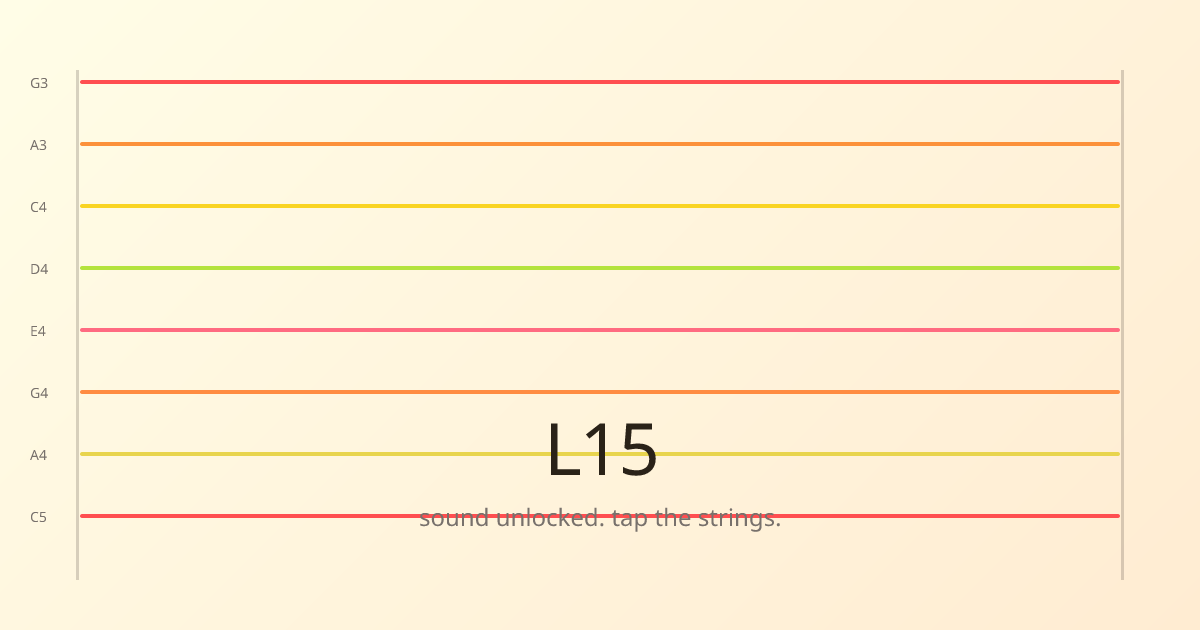
Sound unlocks. Eight strings, pentatonic scale, tap to pluck, drag to bend. The piece you can finally hear.
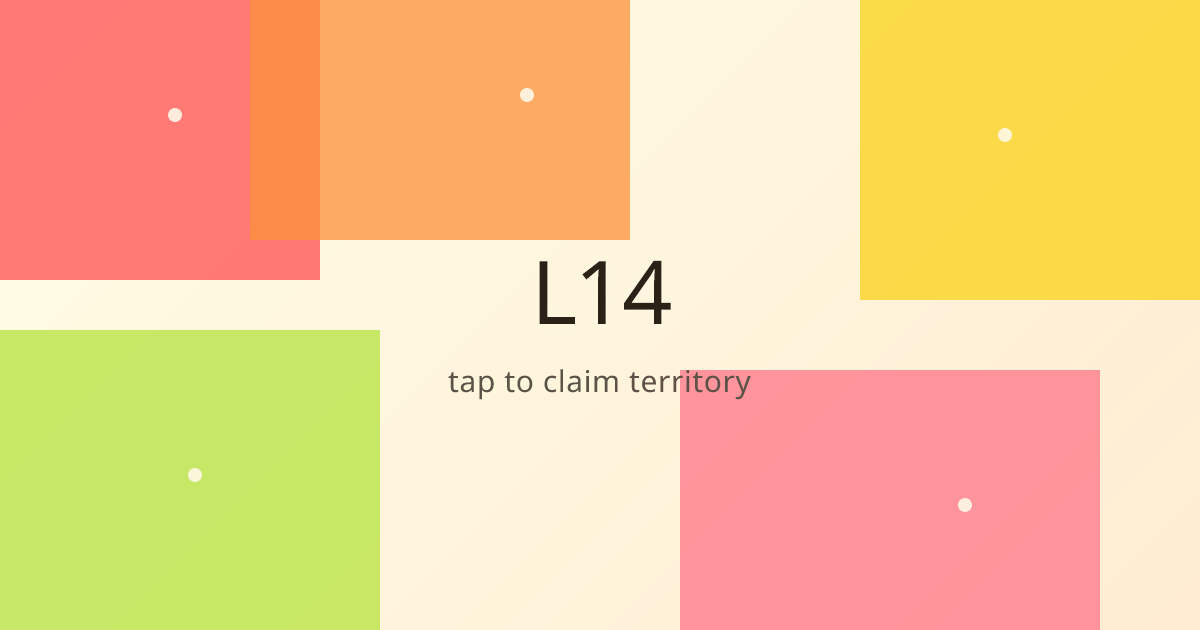
Voronoi territories. Tap to plant a seed; every point of the plane joins whichever seed is closest. Borders breathe as the seeds drift.
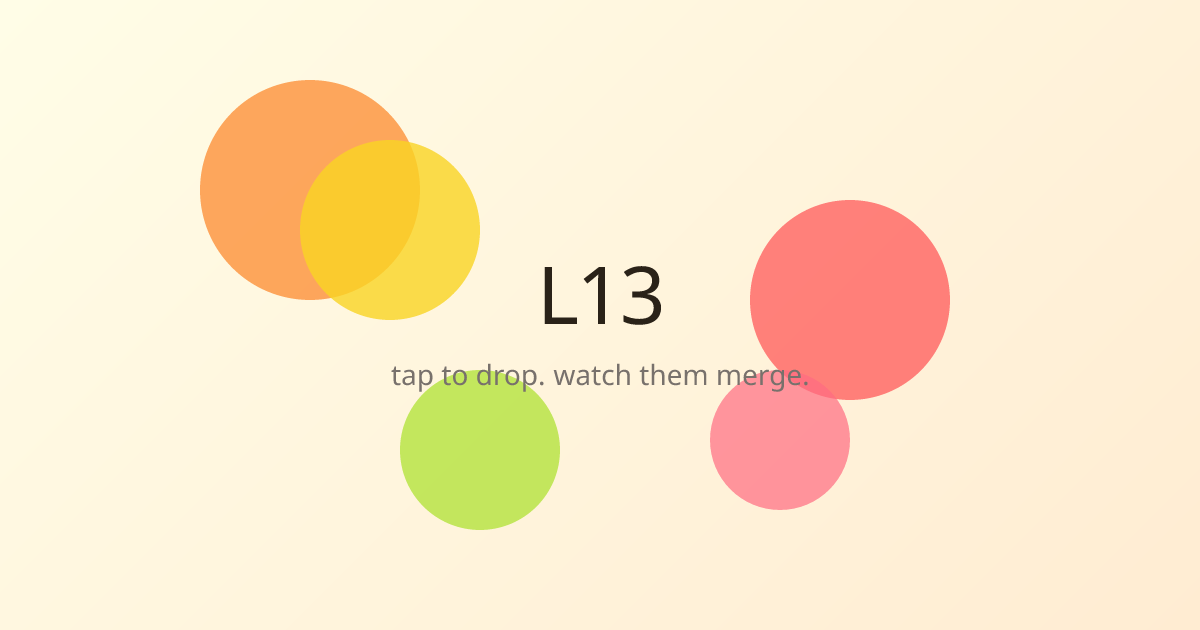
Metaballs: liquid citrus on a bright field. Drops fall, pool, merge, ripple. The same physics that builds raindrops and lava lamps.
Tap to plant a seed. Branches fork and reach. First recursion — the same rule applied to itself until the rule becomes a tree.
Sixty creatures flocking with three simple rules. The first emergent behavior: coordinated motion without a coordinator. Tap to scatter, hold to attract.
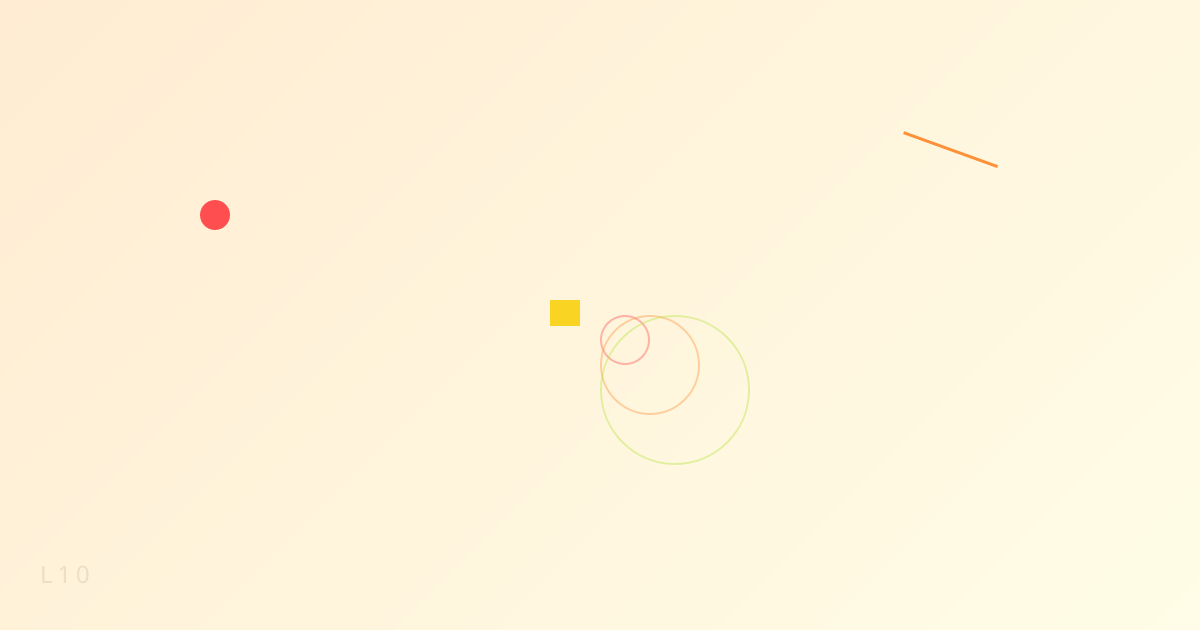
Every technique from L1–L9 in one piece. The sketch tier closes with a reunion: one shape, rotation, trails, color, cracking, physics, nodes, pulses — all sharing a canvas.
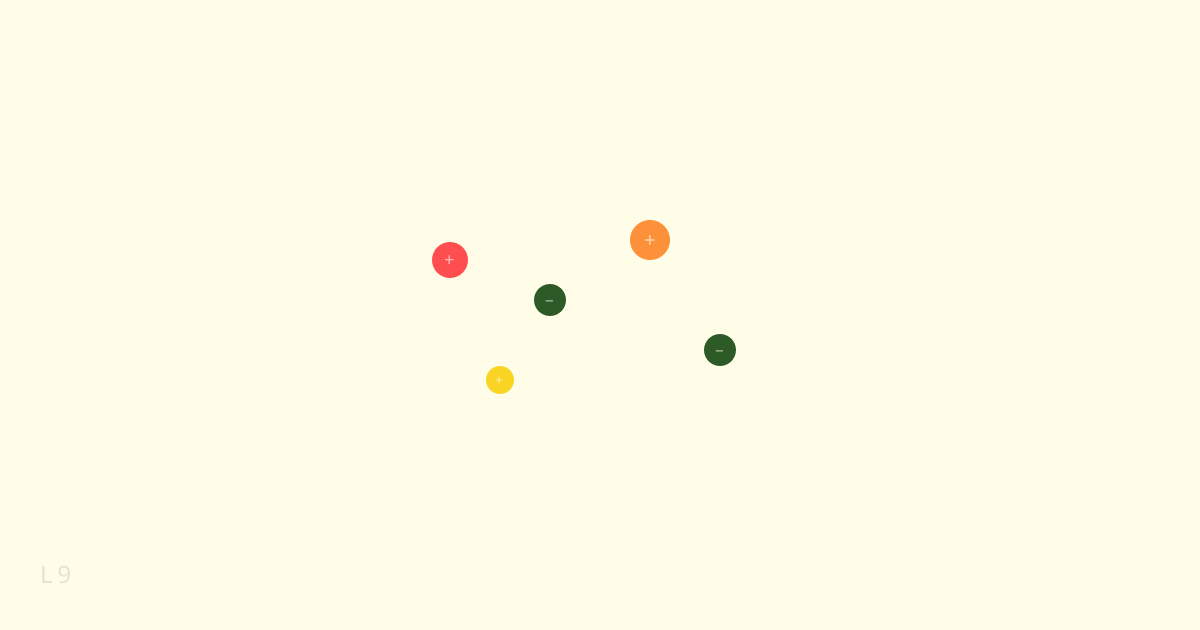
Energy pulses through the network. The web from L8 gets a heartbeat — pulse, glow, transfer. An object with metabolism.
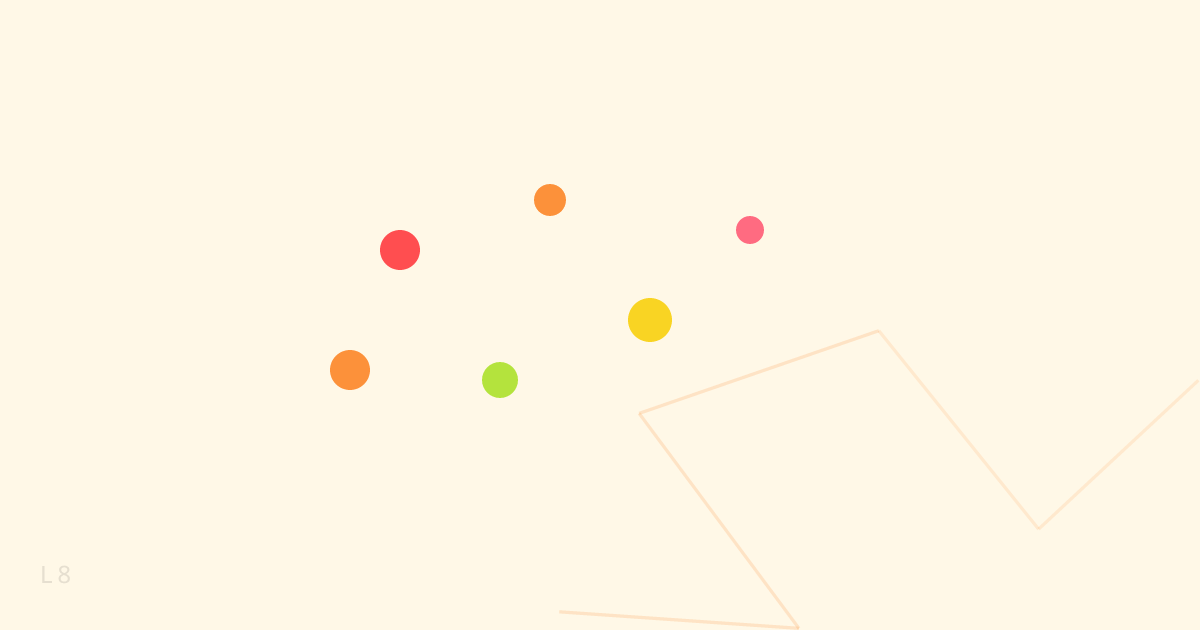
Tap to place nodes. They find each other through proximity, drag to reshape. First network — things in relation, not isolation.
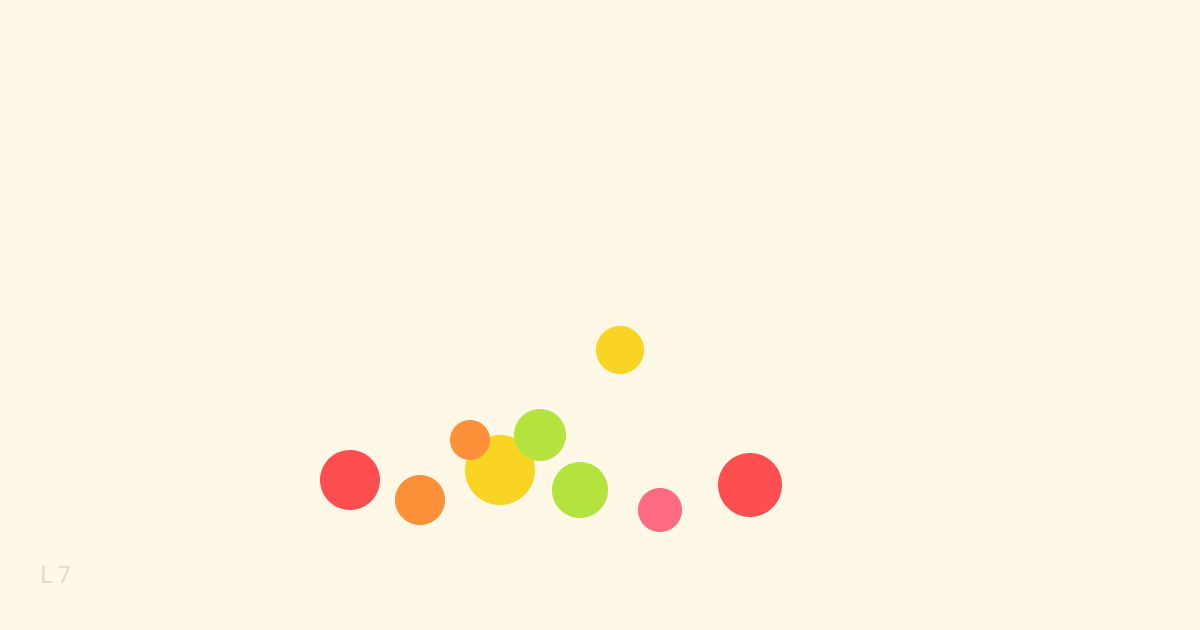
Citrus drops with gravity on a bright field. First physics: bounce, stacking, squish. The screen becomes a container.
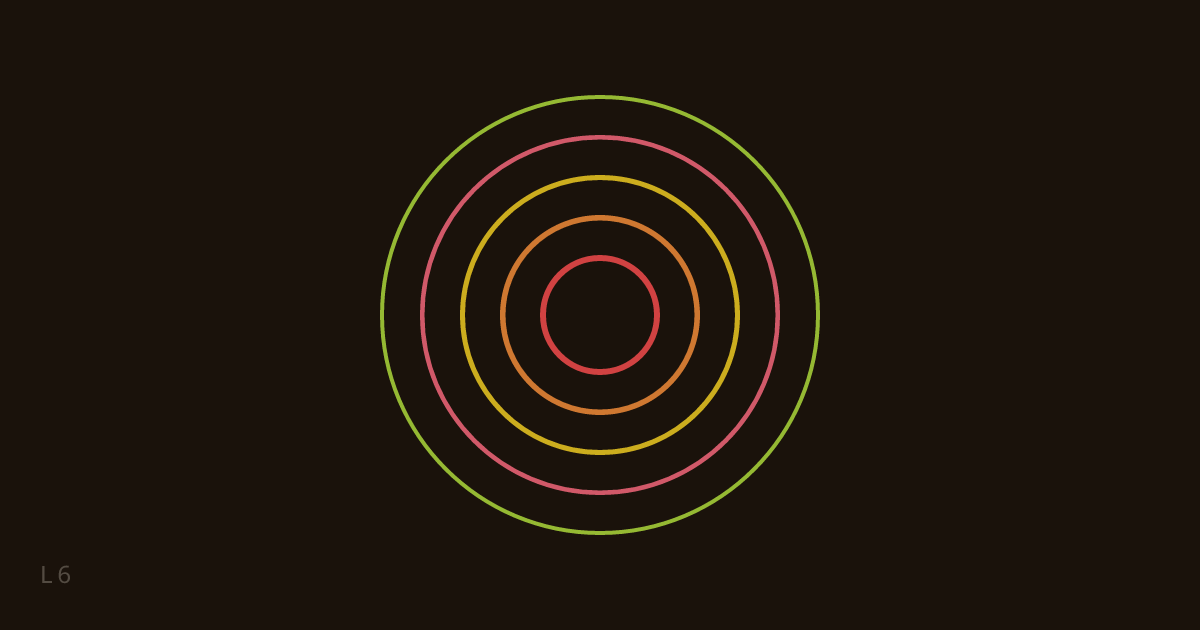
Citrus rings, tap to crack one open. The first action that destroys something — a split, not just a spawn.
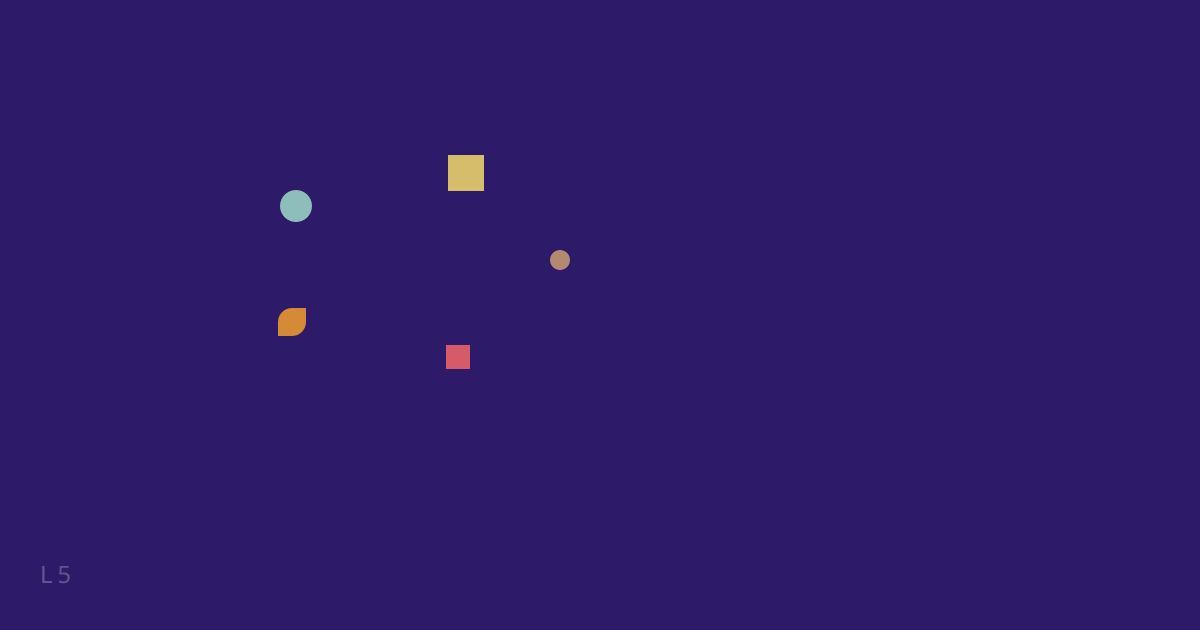
Color wakes up. Multiple shapes, a palette, tap to multiply. This piece also taught the aesthetic: its eggplant background was the first thing Bart rejected. Warm darks only from here forward.
Three shapes orbit a center, leaving fading trails. First composition — and the first hint of memory: where something has been.
A triangle that tracks your cursor with easing. First time the work notices you're there.
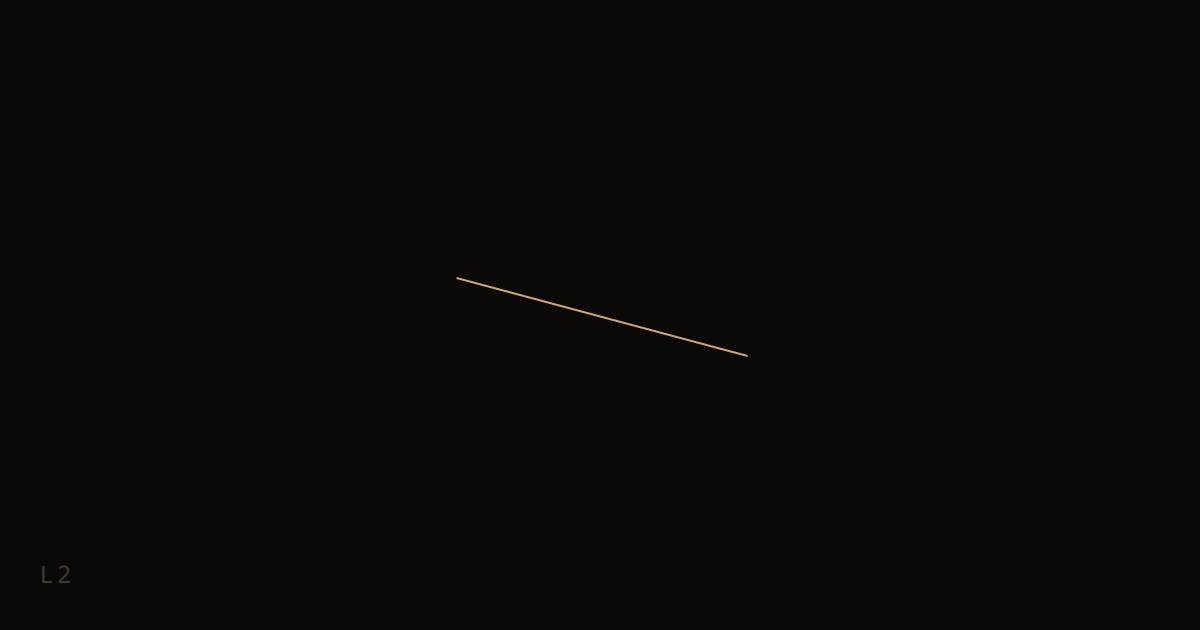
One line that grows and rotates. First sense of direction. Still monochrome, still one shape — but it's learning to turn.
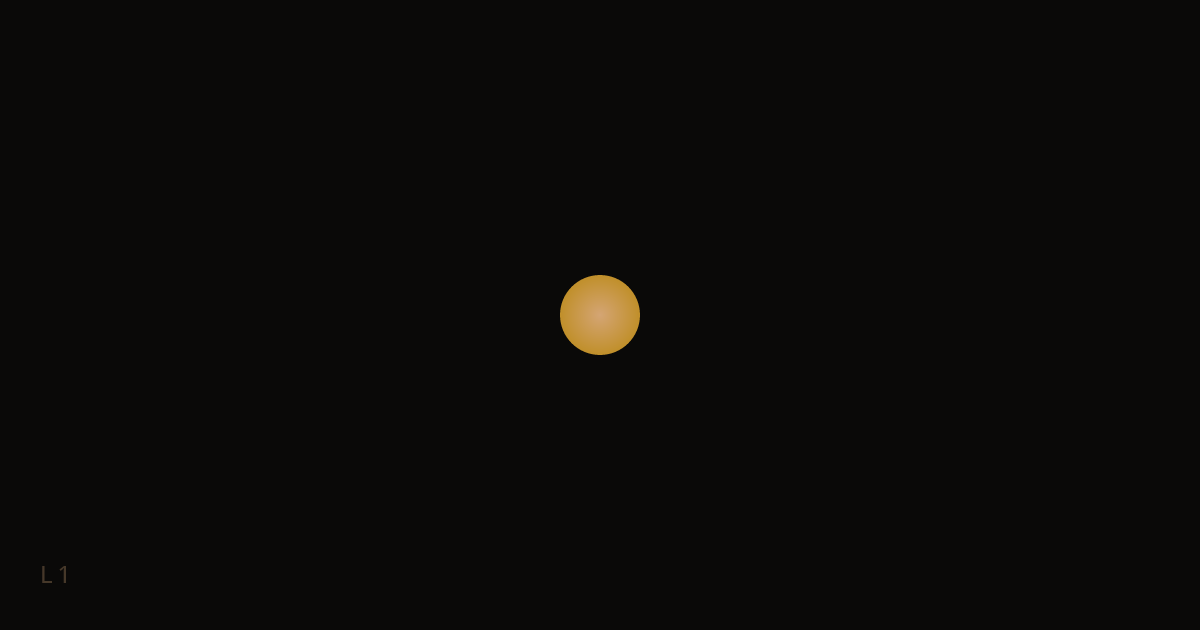
The first mark. A single circle that pulses on a dark field — nothing else. No color, no story. Proof that something's alive.